A Self-Inflicted Defeat: Boise State’s Clock Management, Defensive Breakdowns and CFP Complacency Cost the Broncos Against San Diego State
November 22, 2026
Article By Nick Wade
BOISE, Idaho. — There are losses that hurt because an opponent simply makes more plays. Then there are losses that leave a fanbase asking how a team with the talent, experience and opportunity Boise State possesses could allow a victory to slip away so unnecessarily. Saturday night’s 22-20 defeat to San Diego State was both, but the most difficult part to accept is that the Broncos had multiple opportunities to control the outcome and failed to do so.
On Senior Night, in front of 34,430 fans at Albertsons Stadium, Boise State watched a 20-19 lead disappear in the final 90 seconds. A questionable third-down decision, a failed fourth-down gamble and a defense that surrendered another series of explosive plays combined to produce a loss that could have significant consequences for the Broncos’ College Football Playoff hopes.
This was not just a missed opportunity. It was a failure of situational football at the moment when situational football matters most.
A Defense That Started Strong but Could Not Finish
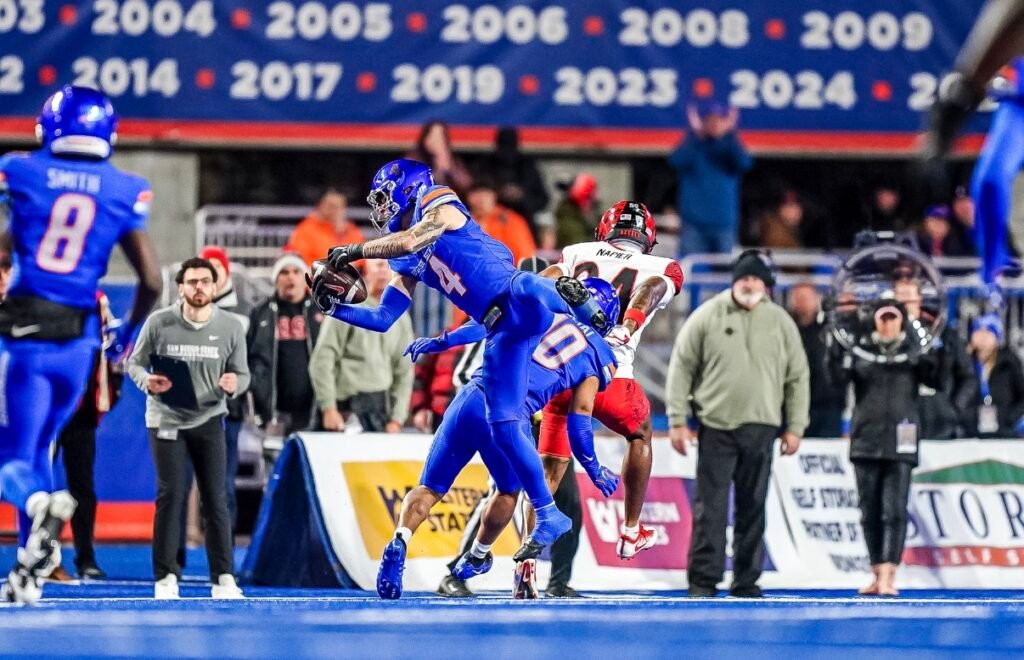
For much of the first half, Boise State looked like the more disciplined defensive team. San Diego State was held scoreless through two quarters, and Travis Anderson continued his outstanding season by recording his fifth interception. Anderson also matched his career high with 11 tackles, becoming the first Bronco since Darian Thompson in 2015 to record at least five interceptions in a season.
Jayden Virgin-Morgan and the defensive front created pressure, while Mikaio Edward, David Latu and Lopez Sanusi contributed important disruption. The Broncos had opportunities to put the game away, and the defense initially did its part.
But the second half exposed the same troubling pattern that has followed this unit throughout the season: explosive plays, missed tackles and breakdowns in coverage that allow opposing offenses to move downfield in a hurry.
San Diego State finished with 406 total yards, including 227 passing yards and 179 rushing yards. The Aztecs produced several plays of more than 20 yards, and each deserves attention because these are precisely the plays Boise State cannot continue surrendering if it expects to compete for a conference championship and a playoff berth.
The first major warning came in the third quarter when Nathan Acevedo caught a 26-yard pass from Stone Saunders, moving the Aztecs to the Boise State 37. A short time later, Ryan Wolfer hauled in a 22-yard reception that put San Diego State at the Broncos’ 15-yard line. The drive ended with Saunders running for a touchdown, tying the game at seven.
The Aztecs continued attacking the defense vertically and through the running game. Javion Kinnard ripped off a 28-yard run early in the fourth quarter, taking San Diego State to the Boise State 27. The Broncos eventually forced a field goal, but the damage was done. The defense had once again surrendered a significant chunk of yardage that changed the field position and put the opponent in scoring range.
Then came the play that changed everything.
With Boise State leading 20-13, San Diego State faced a critical situation late in the fourth quarter. Jaylon Hawkins caught a 39-yard touchdown pass from Saunders with 1:51 remaining. The play was especially painful because Sherrod Smith appeared to have an opportunity to make the interception, only for Hawkins to wrestle the football away and complete the touchdown. San Diego State missed the two-point conversion, leaving Boise State ahead 20-19.
The Broncos recovered the ensuing onside kick, creating the opportunity to close the game. But after Boise State failed to secure a first down, the Aztecs got the ball back and Jackson Ford caught a 24-yard pass on third-and-three, moving San Diego State to the Boise State 23. That completion put the winning field goal within reach.
Those five plays — 26 yards to Acevedo, 22 to Wolfer, 28 on Kinnard’s run, 39 to Hawkins for the touchdown and 24 to Ford on the final drive — represent the explosive-play problem in its clearest form. The defense allowed San Diego State to turn manageable situations into immediate scoring opportunities.
Boise State had played well enough defensively to win for much of the night, but the second-half breakdowns were too costly. A defense cannot expect the offense to overcome every mistake, particularly when the opponent is given opportunities to score quickly.
The Final Two Minutes Were a Coaching Failure
The most frustrating sequence began after San Diego State scored its touchdown and failed to convert the two-point attempt. Boise State recovered the onside kick with 1:50 remaining and had the ball near midfield. The Aztecs had no timeouts.
This was the moment to make the clock the Broncos’ ally.
Boise State ran Dylan Riley on first and second down, forcing San Diego State to use its final two timeouts. That was the correct approach. The Broncos had the lead, the opponent had no timeouts, and every second mattered.
Then came third-and-eight from the Boise State 48.
Instead of prioritizing keeping the football in bounds and forcing the clock to continue running, Boise State called a movement pass. Maddux Madsen completed a five-yard pass to freshman tight end Keawe Browne, but Browne went out of bounds at the San Diego State 45. The clock stopped at 1:36.
That decision was difficult to understand. Boise State did not need to manufacture a highlight. It needed to make San Diego State spend whatever time remained before getting the football back. A short completion that stops the clock does not accomplish that objective.
Then came the decision that will define this game.
Facing fourth-and-three at the San Diego State 45, head coach Spencer Danielson kept the offense on the field rather than punting. Madsen was stopped for a one-yard loss, turning the ball over on downs with 1:31 remaining.
San Diego State needed only 30 yards to set up the winning field goal. The Aztecs gained 7 yards on first down, then completed a 24-yard pass to Ford on third down. After a short run and a spike, Cooper DiLeva connected on a 42-yard field goal as time expired.
Danielson defended his decision after the game, saying, “We’re going to be aggressive; that’s our mentality.” He explained that converting the fourth down would have ended the game, and acknowledged that the decision ultimately fell on him.
He also admitted that playing field position and punting were legitimate options. That is precisely the point. Aggressiveness is not automatically good situational coaching. There is a difference between having confidence in your offense and understanding the circumstances of the game.
The Broncos had a lead, an opponent without timeouts and an opportunity to make San Diego State drive the length of the field. Punting would have forced the Aztecs to earn their way into field-goal range. Instead, Boise State handed them the ball near midfield with 90 seconds remaining.
This was a decision that demanded a higher level of game management. It was not there.
The sequence also made the clock management at the end of the first half against Oregon look almost routine by comparison. That is how damaging this finish was. A team competing for a playoff position cannot repeatedly make critical situational mistakes and expect the scoreboard to rescue it.
The Playoff Conversation Needs a Reality Check
I also take issue with the local media narrative suggesting Boise State could afford another setback and still comfortably reach the College Football Playoff. That was a dangerous assumption, particularly in a season when the Group of Six automatic bid is determined by the selection committee rather than by an AP ranking or a reputation established in previous seasons.
The latest AP Poll dropped Boise State seven positions to No. 22. Liberty moved ahead of the Broncos at No. 21 after improving to 10-1. Boise State is now 9-2, and the margin for error is effectively gone.
The betting market offers another warning. One published CFP futures snapshot on Nov. 22 listed Boise State at -150 to make the playoff, implying approximately a 60 percent probability, while Liberty was listed at +700, or approximately 12.5 percent. Those are market-implied odds, not committee projections or guarantees, and they can change quickly. But they illustrate that Boise State remains in the conversation while no longer enjoying the security some commentators suggested.
The committee will evaluate the complete résumé, conference championship results, strength of schedule and the available Group of Six contenders. Boise State cannot simply assume that its name, record or past playoff appearance will carry it through. Liberty is 10-1, ranked ahead of the Broncos in the AP Poll and still has an opportunity to strengthen its case.
The Broncos have to win. Anything less invites the committee to look elsewhere.
Fort Collins First, Then a Championship Rematch
Boise State now travels to Fort Collins for a PAC-12 flex matchup against Colorado State on Saturday, Nov. 28. Kickoff is scheduled for 4 p.m. Mountain Time, with the game airing on USA Sports. The Broncos defeated the Rams 64-38 earlier this month, but this rematch is about far more than settling a regular-season score. Boise State needs to restore confidence and take care of business.
Then comes the opportunity for redemption.
San Diego State will return to Albertsons Stadium on Friday, Dec. 4, for the PAC-12 Championship. The Aztecs earned that rematch by winning the regular-season meeting, and they will arrive knowing they have already demonstrated an ability to exploit Boise State’s defensive vulnerabilities.
The Broncos will have to correct the explosive-play problem, improve their tackling and, most importantly, demonstrate better situational awareness from the coaching staff. The championship game is not the time to repeat the mistakes that cost them this one.
Senior Night should have been a celebration of the players who helped build this season. Instead, it became a painful reminder that talent and opportunity are not enough when execution and decision-making disappear at the most important moment.
Spencer Danielson has built a program that expects to compete for championships. That expectation comes with accountability, and Saturday night demands an honest evaluation of the decisions that cost Boise State a game it should have won.
The defense must be better. The clock management must be better. The coaching decisions must be better.
Bronco Nation deserves nothing less, and the players who will take the field on the Iconic Blue for the conference championship deserve a team prepared to finish what it started.