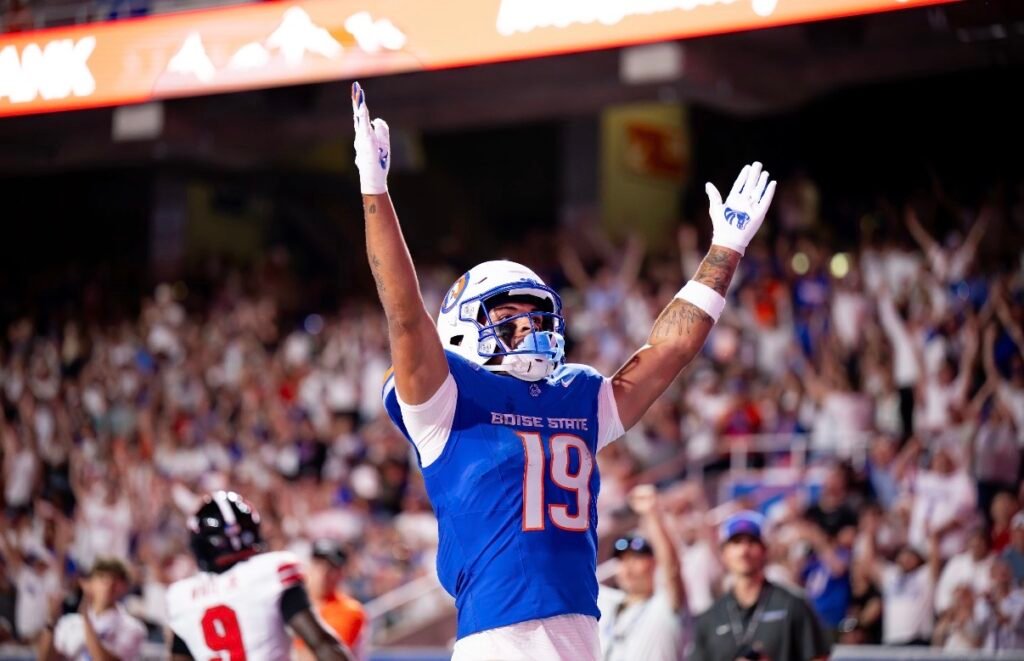
Dylan Riley &Travis Anderson Deliver As Boise State Survives South Dakota
September 20, 2026
Article By Nick Wade
BOISE, Idaho — For nearly three quarters Saturday night, Boise State and South Dakota played a game that refused to follow the script. The Broncos entered Albertsons Stadium looking to build on consecutive strong performances against No. 2 Oregon and Memphis, while the No. 10-ranked FCS Coyotes arrived with an undefeated record and the confidence of a program that believed it belonged on the blue turf. By the time the final whistle arrived, Boise State had its second consecutive victory and a 38-24 final score that looked considerably more comfortable than the game actually felt.
Dylan Riley eventually changed that feeling. Travis Anderson made sure it stayed that way. Riley’s 83-yard touchdown run with 1:33 remaining provided the exclamation point, while Anderson intercepted Austyn Modrzewski for the second time of the night on South Dakota’s ensuing possession to close the door. Boise State improved to 2-1, while South Dakota fell to 3-1.
For Bronco Nation, the night produced plenty to celebrate, but it also produced another reminder that this Boise State team still has work to do. The Broncos ran for 325 yards, produced 533 yards of total offense and controlled the football for 39:26. They converted 8 of 13 third downs, finished with 29 first downs and averaged 6.8 yards per rushing attempt. South Dakota managed only 279 total yards and 36 rushing yards, but 243 passing yards and several explosive completions kept the Coyotes within striking distance until the final minutes.
That contrast may be the best description of Boise State’s night. There was dominance. There was also vulnerability. And in the end, the Broncos found enough answers to win.
Riley was again the offensive engine and our Offensive Player of the Game. The junior running back carried 26 times for 198 yards and two touchdowns, averaging 7.6 yards per carry. His 83-yard touchdown in the fourth quarter was his longest run of the season and came after he had already given Boise State the lead with a two-yard touchdown run with 6:25 remaining. Riley also caught two passes for 18 yards, finishing with 216 yards from scrimmage.
The final numbers were impressive, but the timing of the production was even more important. With the game tied 24-24, Boise State needed someone to take control. Riley did exactly that. The first touchdown came at the end of a 75-yard, nine-play drive that consumed more than four minutes. After South Dakota reached the red zone and was stopped on downs, Riley needed only one play to turn a tense night into a two-score game. Eighty-three yards later, the Coyotes were chasing the Broncos again.
Riley’s performance also helped create another remarkable milestone for the Boise State ground game. Riley and Sire Gaines both surpassed 100 rushing yards, marking the 15th time Boise State has produced two 100-yard rushers in the same game since joining the FBS in 1996. Gaines finished with 102 yards on 17 carries and a touchdown. That is not simply a statistical footnote. It is becoming a defining characteristic of this Boise State offense.
The Broncos finished with 325 rushing yards on 48 attempts, averaging 6.8 yards per carry. Madsen added 19 rushing yards, while Rasean Jones contributed eight yards on one carry. Maddux Madsen did his part through the air as well, completing 22 of 31 passes for 208 yards and two touchdowns without throwing an interception. He connected with Jones for a nine-yard touchdown late in the first quarter and Cam Bates for a four-yard score in the second.
Jones continued to look like one of the most important emerging pieces of this offense. The true freshman caught eight passes for 95 yards and a touchdown, giving him a team-high in receptions and making him a consistent answer whenever the Broncos needed to move the chains. His first touchdown came after Boise State had struggled to generate momentum early.
Riley’s fumble inside the Boise State 20-yard line gave South Dakota a short field, and Bryce Cohoon converted the opportunity with a 16-yard touchdown reception. The Coyotes then answered Boise State’s first touchdown with another scoring drive, taking a 14-7 lead early in the second quarter. The Broncos responded with the kind of physical football that has become increasingly familiar. A 12-play, 70-yard drive ended with Gaines powering into the end zone from three yards out. Then Anderson delivered the play that changed the momentum.
With South Dakota threatening again, Anderson stepped in front of Modrzewski’s pass for his first interception of the night. Boise State turned the takeaway into points when Madsen found Bates for a four-yard touchdown, giving the Broncos a 21-14 halftime advantage.
Anderson would eventually become our Defensive Player of the Game. His two interceptions were the first multi-interception performance by a Boise State player since Jeremiah Earby against Colorado State in November 2025. Anderson’s second interception came with 1:18 remaining, immediately after Jayden Virgin-Morgan sacked Modrzewski for a nine-yard loss. The final stat line was modest beyond the interceptions: two total tackles, one pass breakup and two interceptions for two yards. But defensive statistics do not always capture impact. Anderson’s first interception helped Boise State seize control before halftime. His second ended the game. That is impact.
The defense deserves credit for holding South Dakota to only 36 rushing yards, but the passing defense remains the biggest question coming out of the victory. South Dakota completed only 12 passes, but those completions went for 243 yards, an average of 20.3 yards per completion. Tennel Bryant caught three passes for 104 yards, while Tysen Boze had three catches for 73 yards and two touchdowns, including a 59-yard score in the third quarter.
From the stands, it felt like the same problem that has followed the Broncos through the opening weeks of the season. The secondary can make spectacular plays, but it is also giving opposing quarterbacks opportunities to change games with a handful of throws. South Dakota had roughly three or four explosive plays that kept the Coyotes alive. That cannot continue indefinitely.
Spencer Danielson didn’t hide from the issue after the game. “Obviously, we have a lot of work to do,” Danielson said. “There’s a lot of stuff we need to clean up, but I still do believe that we’re building.” His comments about the passing defense were even more direct. “We’re giving up way too many explosive plays, especially through the air right now,” Danielson said. “It has to change.”
That is an important distinction. The defense is not incapable of making plays. Anderson produced two interceptions. Virgin-Morgan recorded a sack. Boen Phelps led Boise State with five tackles and added a tackle for loss. Mikaio Edward contributed half a sack, while Sherrod Smith recorded four tackles and 1.5 tackles for loss. The front also held South Dakota’s running game to just 36 yards.
The issue is that a defense can play well for long stretches and still put itself in difficult situations when explosive passes are allowed. Danielson acknowledged that directly. “There’s some really good parts in that game of us playing really good defense, and there’s some absolutely atrocious stuff on film,” he said. “We’ve got to get it fixed.”
That may be the most honest assessment of where Boise State stands after three games. There are legitimate signs of progress. There are also problems that have become difficult to ignore. And there is still time to address them.
South Dakota deserves credit for making Boise State work for the victory. The Coyotes came into Albertsons Stadium ranked No. 10 in the FCS and played with the confidence of a team that believed it could win. They scored 24 points, tied the game at 24 in the fourth quarter and forced Boise State into a tense final five minutes.
But Boise State responded. After a Cam Bates muffed punt gave South Dakota possession deep in Bronco territory, the defense produced perhaps its most important stand of the evening. The Coyotes reached the red zone but could not finish the drive, turning the ball over on downs with 1:44 remaining.
That sequence set up Riley’s defining moment. One play. Eighty-three yards. Game over.
For all the frustration surrounding portions of the evening, that is also something worth recognizing about this Boise State team. It continues to find ways to finish. Rasean Jones described the night as “a hard-fought team win” and called it “a great learning experience,” saying the Broncos saw flaws they needed to correct while also proving they could “fight through any kind of adversity.”
That may be the most appropriate way to view the South Dakota game. Not as a collapse. Not as a perfect performance. As a lesson. Boise State dominated the line of scrimmage, ran for 325 yards, controlled nearly 40 minutes of possession, produced 29 first downs and finished with 533 total yards. The Broncos also committed two turnovers, surrendered several explosive passes and allowed South Dakota to stay within one score until Riley finally broke the game open.
The 34,428 fans who packed Albertsons Stadium witnessed something more complicated than the final score suggests. They saw a football team with a powerful running game. They saw a young receiver in Jones continue to emerge. They saw Anderson develop into a playmaker at safety. They saw a defense capable of shutting down the run and producing timely takeaways. They also saw a secondary that still has to eliminate the explosive plays that can turn a manageable Saturday into a dangerous one.
Danielson understands the assignment. “We did not play our best tonight,” he said. “We’ve got to get better.”
That is where Boise State heads next. The Broncos are 2-1 entering their final nonconference game at Western Michigan, but the South Dakota victory offered something more valuable than simply another win. It offered another piece of evidence about what this team can become.
Riley is becoming a force. Gaines gives Boise State a second 100-yard weapon. Jones is emerging as a legitimate receiving threat. Madsen continues to protect the football. Anderson is proving that the safety position can create game-changing plays.
Now the secondary has to turn those flashes into consistency. Because if Boise State can pair its increasingly dominant ground game with a defense that eliminates the explosive plays, the Broncos will not have to rely on another 83-yard rescue every Saturday night.
For now, though, Riley’s sprint down the blue turf and Anderson’s second interception tell the story. Boise State found a way. And in a season built around a new era, the next step is making sure the lessons from South Dakota become part of the foundation rather than a recurring storyline.