The North End Zone Debate: Bronco Nation Can Disagree Without Dividing
September 15, 2026
Article By Nick Wade Bronco Nation Updates/NewsTalk KBOI
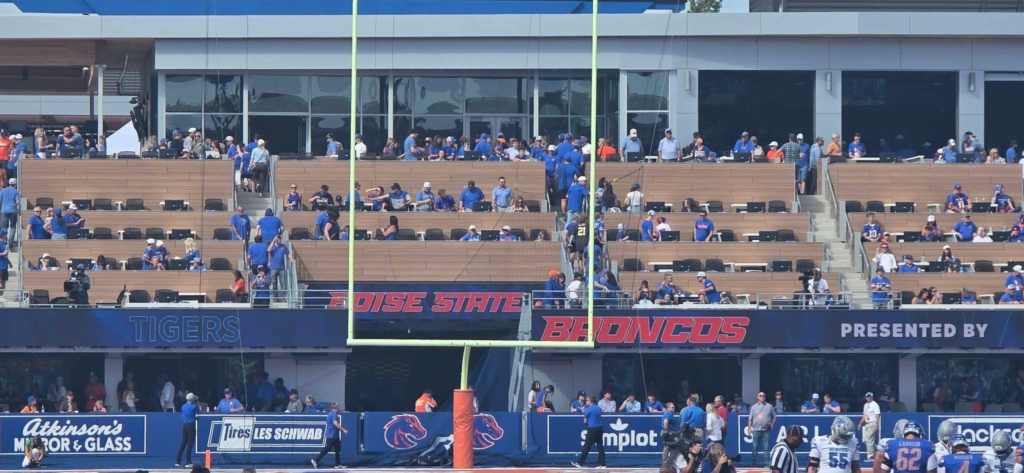
ALBERTSONS STADIUM, Idaho — The North End Zone is finally open, and with it has come something that may be every bit as predictable as the first kickoff of a new season: Bronco Nation has opinions. Some fans love what Boise State has built. Others have questioned the aesthetics, particularly the wood-toned finishes and the amount of gray surrounding the premium seating areas. Some believe the new North End Zone looks impressive in person but does not translate as well on television. Others have focused on something much more emotional for a Boise State fan: the sound.
Was the North End Zone supposed to make Albertsons Stadium louder? After watching the home opener against Memphis, some fans came away believing the new structure has taken something away from the traditional chaos of the old north end zone. The criticism has centered on empty-looking sections, premium seating that can appear quieter than the traditional general-admission environment and the perception that an end zone that once felt packed with blue-collar energy now feels more corporate.
Those concerns deserve to be heard. So do the fans who see something entirely different. The North End Zone was never designed simply to recreate the old north end zone with nicer seats. It was designed to fundamentally change how Boise State monetizes Albertsons Stadium while creating a year-round commercial asset capable of helping the athletic department compete in an entirely different era of college athletics. That distinction matters.
I had the opportunity to see that vision firsthand during the summer when Nate and Sophie sent me on a tour of the project. I came away impressed enough that I wrote about what Boise State was building and produced an 11-minute tutorial video for NewsTalk KBOI explaining the project and how the new spaces were designed to function. For those who want to understand the North End Zone beyond what a television camera shows during a football game, my original KBOI article and tour video remain two of the best ways to see what Boise State was trying to accomplish.
The important point is that Boise State did not spend approximately $70 million simply to add seats. The project adds approximately 1,600 premium seating opportunities, including 12 field-level suites, 44 loge boxes, 148 ledge seats and more than 800 club seats. Boise State’s original project announcement made the financial strategy clear: the new premium inventory was intended to create additional revenue while improving the overall stadium experience. The response has already been significant, with the suites, loge boxes and ledge seats sold out and only a limited number of club seats remaining.
That is an important piece of this conversation because the North End Zone cannot be judged solely by whether it looks better on television or whether the first home game sounded louder from one section of the stadium. It must be judged by what it can do for Boise State five, 10 and 20 years from now.
And that brings us to the uncomfortable part of modern college athletics. Boise State is competing against schools with dramatically different financial resources. The Broncos have built a national brand without possessing the athletic budget of many of the programs they now encounter in the evolving college football landscape. The numbers are becoming impossible to ignore.
Boise State Athletics reported a roughly $2 million deficit for the previous fiscal year, while projections for the coming fiscal year have placed the potential cumulative deficit between $14 million and $18 million. Student-athlete revenue sharing is expected to rise to approximately $13.5 million, while Boise State also faces the additional financial realities associated with operating in the PAC-12.
This is where the North End Zone becomes much bigger than football seating. Boise State Athletic Director Jeramiah Dickey has been remarkably direct about the challenge. “We don’t need what everyone else has. We just need more than we currently have.” That statement may be the single best explanation for the North End Zone. Boise State does not need to become Oregon, Texas or Ohio State. It needs to create enough sustainable revenue to close the gap between where it is and where the modern college athletics marketplace is going.
And that is why the creation of the Boise State Sports & Entertainment Group may ultimately be just as important as the construction itself. Boise State launched the group this year specifically to turn Albertsons Stadium and ExtraMile Arena into year-round entertainment destinations. Concerts, special events, corporate functions, community gatherings and other non-athletic activities are part of the strategy. Dickey described the objective plainly: Boise State wants to become a “365-day destination for fans.”
That changes the conversation. The North End Zone isn’t supposed to make all of its money from six Boise State football Saturdays. It is supposed to work when the Broncos are playing Oregon. It is supposed to work when Boise State is playing Memphis. It is supposed to work when there isn’t a football game at all.
That is the part of the project that can be easy to miss when we look at a television shot and ask whether the seats are full. The real question is whether those spaces can generate recurring revenue that can eventually be reinvested into student-athletes, coaches, facilities, Olympic sports, fan amenities and competitive resources. Boise State itself has said the Sports & Entertainment Group exists to create revenue opportunities that support student-athletes, while expanding the use of its venues beyond traditional athletic events.
That does not mean every criticism should be dismissed. Quite the opposite. If Bronco Nation believes the North End Zone does not look enough like Boise State, that feedback matters. If fans believe the wood and neutral tones should have incorporated more blue, that conversation is legitimate. If supporters believe the seating configuration needs to create a louder, more unified environment, that deserves attention. And if longtime fans are uncomfortable watching premium seating replace some of the visual density and raw energy that made the old north end zone special, their feelings are valid too.
Boise State’s home-field advantage has always been built on more than architecture. It has been built on people. Spencer Danielson has repeatedly talked about the importance of Bronco Nation’s presence inside Albertsons Stadium. He has described the fans as being “in the game” with the team because of how loudly they support the Broncos. That culture cannot be purchased with a construction budget. It has to be cultivated.
That may ultimately be the opportunity hidden inside the controversy. Instead of choosing between premium seating and passion, Boise State and Bronco Nation should find ways to make the two work together. If the North End Zone needs more blue visually, find creative ways to bring more blue into the experience. If it needs to be louder, create traditions that make every person in that section want to participate. If premium ticket holders are spending portions of the game inside hospitality spaces, create incentives and experiences that pull them back toward the field for critical moments. If general admission fans feel priced out, continue finding ways to preserve affordable opportunities for students, families and longtime supporters.
The solution does not have to be one side defeating another. It can be everyone pulling in the same direction. That is especially important because the North End Zone is not an isolated project. Boise State has already demonstrated that premium demand exists. The department announced that its suites, loge boxes and ledge seats had sold out, while its broader fundraising operation surpassed $20 million for the fifth consecutive year and reached more than 10,500 Bronco Athletic Association members.
There is clearly a market for premium experiences. There is also clearly a market for the old Boise State experience. Bronco Nation needs both. The greatest danger isn’t that some fans don’t like the North End Zone. The greatest danger would be allowing disagreement over the North End Zone to become another division inside a fan base that has historically been at its best when it rallies around a common purpose.
College athletics has changed. The money has changed. The stakes have changed. Boise State is attempting to change with them without losing the identity that made the university special in the first place. That is not an easy assignment. The North End Zone may not be perfect. It may never look exactly like what every fan imagined. It may require adjustments to the atmosphere, aesthetics and game-day operation as Boise State learns what works and what does not.
That is okay. A building can be changed. A seating configuration can be adjusted. A tradition can be created. What cannot be easily replaced is Bronco Nation. So rather than declaring the North End Zone a success or failure after one home game, perhaps the better question is what we can make it become.
If the premium spaces generate the revenue Boise State needs, if those dollars help close the competitive gap, if they support revenue sharing and student-athletes across all 18 programs, and if the athletic department continues listening to fans about the atmosphere, then the project can accomplish something much greater than adding suites and club seats. It can help preserve Boise State’s place at the table.
And maybe that is the compromise Bronco Nation needs. Those who love the North End Zone should listen to those who miss the old atmosphere. Those who dislike the aesthetics should recognize the financial strategy behind the building. Those who think it isn’t loud enough should help create the traditions that make it louder. And those who worry about affordability should continue pushing Boise State to ensure that the future of Albertsons Stadium still includes the fans who helped build its history.
We do not need a class war inside Bronco Nation. We need a common cause. Boise State has spent decades proving that it can find a way to compete when the odds, resources and expectations suggest otherwise. The North End Zone is simply the newest chapter in that story. The challenge now belongs to all of us.
Make it work. Make it loud. Make it feel like Boise State. And, most importantly, make sure the revenue it generates helps ensure that the Broncos can keep competing at the highest level of college football for generations to come.