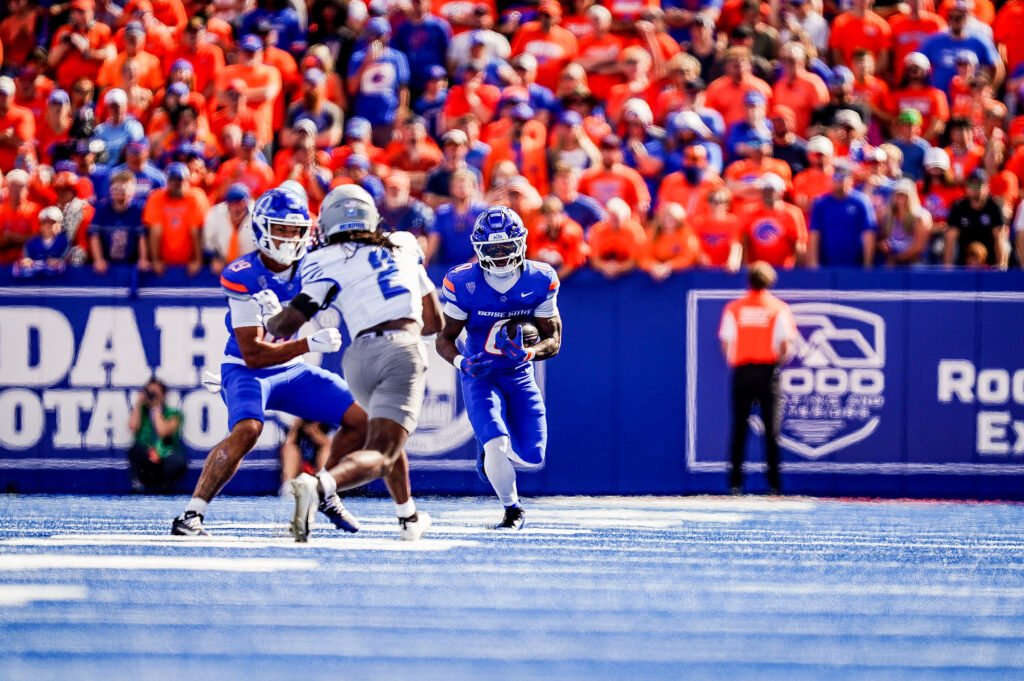
Boise State’s Defense &Tee Dog Bourbon Overcome First Half Adversity
September 13, 2026
Article By Nick Wade
BOISE, Idaho — The 40th anniversary of Boise State’s Iconic Blue was never going to be an ordinary home opener. Neither was the first home game of the Broncos’ inaugural season in the PAC-12. There were custom anniversary helmets, a new conference banner hanging over a program that has spent decades building its reputation far beyond the borders of Idaho, 34,439 fans packed into Albertsons Stadium, and a new four-legged member of Bronco Nation ready to carry on one of the most recognizable traditions in college football.
Bourbon, Boise State’s new official Tee Dog, made her debut as the successor to Blitz, following the retirement of her brother last season. Boise State had officially announced Bourbon as the program’s new Tee Dog entering the season, though she struggled to get acclimated filling the Legend Blitz’s paw prints, it gave another beloved dog the opportunity to become part of the theater that surrounds The Blue.
For a while Saturday afternoon, however, it looked as though the biggest story of the night might be a Boise State team that had not learned from the mistakes that nearly cost it against Oregon. Then the Broncos remembered who they were. Boise State erased a 17-3 deficit, scored 35 of the game’s final 38 points and overwhelmed Memphis 38-20 in a comeback that was as revealing as it was impressive.
The Broncos are now 1-1, have their first victory as members of the PAC-12, improved to 28-3 in home openers since joining the FBS ranks and gave head coach Spencer Danielson his 25th career victory at Boise State. The program has now won 24 of its last 25 home openers and seven consecutive nonconference home games. But this was not a perfect performance. It was a response. And perhaps that distinction is more important for a team entering a monumental season than a comfortable final score would suggest.
The Broncos were beaten badly in the explosive-play department during the opening half, and the defensive secondary once again showed a vulnerability that must be corrected if Boise State intends to compete for championships in the PAC-12. Memphis quarterback Marcus Stokes finished 17-of-26 for 384 yards and a touchdown, while the Tigers generated 519 yards of total offense. Memphis had 17 first downs, but Boise State allowed the Tigers to average 10.0 yards per offensive play.
The Broncos, by comparison, produced 578 yards, including 357 on the ground, while averaging 7.7 yards per play. Boise State finished with 28 first downs and controlled the game physically once it found its rhythm. Those numbers tell two very different stories. The first is that Boise State’s offense may be capable of carrying an enormous load this season. The second is that the defense cannot continue surrendering chunk plays at the rate it did Saturday.
That was particularly obvious during a first half in which Memphis repeatedly found the Broncos’ secondary vulnerable. The warning signs arrived early. Boise State opened the afternoon with a methodical drive that covered 53 yards in 12 plays before Canaan Moore drilled a 39-yard field goal to put the Broncos ahead 3-0. Moore remains perfect on his field-goal attempts this season, and his opening kick gave Boise State points on its first offensive possession for the second consecutive game.
Then the defense produced its first spark. Memphis drove inside the Boise State red zone, but Boen Phelps got through to block a 20-yard field-goal attempt. It was the kind of play that reflected the physical identity Boise State wants to establish, and it extended the Broncos’ remarkable streak of blocking at least one kick in 28 consecutive seasons.
But the next Memphis possession changed the complexion of the game. Hunter Tipton caught a deep pass from Stokes and raced 87 yards for a touchdown. The secondary had been burned. Again. The Tigers suddenly had a 7-3 advantage, and the Broncos had their first reminder that Memphis was not going to be intimidated by the atmosphere, the anniversary celebration or Boise State’s home-field reputation.
The problem became more pronounced in the second quarter. Boise State put together an impressive drive but failed to score when a fourth-down pass from the Memphis 2-yard line fell incomplete. The crowd voiced its displeasure, sensing that an opportunity had been left on the field. Then Memphis struck again. A 68-yard completion helped move the Tigers deep into Boise State territory, and although the Bronco defense stiffened enough to force a field goal, the damage was done. Memphis had once again flipped the field with one explosive play.
Moments later, Jaylin Carter did it on the ground. Eighty yards. Touchdown. Memphis had a 17-3 lead. The first-half problem was no longer subtle. It was staring Boise State in the face. Tipton’s 87-yard touchdown pass and Carter’s 80-yard touchdown run accounted for two of Memphis’ biggest scoring plays, while additional long completions continued to put pressure on the Bronco secondary. Memphis ultimately finished with 384 passing yards and 135 rushing yards, but that rushing total is somewhat deceptive because Carter’s 80-yard touchdown accounted for nearly 60 percent of his team’s rushing production.
That is exactly why the defensive performance deserves both praise and scrutiny. Boise State gave up 519 yards, but the defense also held Memphis scoreless throughout the second half. The Broncos had sparks. They had playmakers. They had toughness. What they did not have consistently enough was discipline against explosive plays. That has to change.
Danielson acknowledged as much after the game. “There’s a lot to get fixed,” Danielson said, pointing to the more than 500 yards Boise State surrendered and the handful of explosive plays that accounted for a staggering amount of Memphis’ production.
The response, however, began before halftime. With Boise State trailing 17-3 and the home crowd waiting for something to ignite the afternoon, Maddux Madsen found Akeem “Nitro” Wright for a 37-yard touchdown with 2:28 remaining in the second quarter. Then Travis Anderson delivered another spark. The safety intercepted Stokes with roughly two minutes remaining.
Boise State needed only two plays to capitalize. Dylan Riley took the handoff and exploded for 71 yards, instantly changing the field position and the emotional temperature inside Albertsons Stadium. Rasean Jones followed with a 19-yard touchdown run, and suddenly a game that appeared to be slipping away was tied 17-17. It was one of those sequences that changes the way a team sees itself.
Riley was the catalyst. He was also our Boise State Offensive Player of the Game. And there is little argument to make against that choice. The junior running back carried 19 times for a career-high 206 yards, averaging 10.8 yards per carry with a long run of 71 yards. He added two receptions for 11 yards and finished with 217 all-purpose yards. It was Riley’s second career 200-yard rushing performance and the ninth time a Boise State player has eclipsed 200 rushing yards since 2023, which is the most such performances by any FBS program during that span. Riley also rushed for 134 yards in the first half, giving Boise State an offensive lifeline when the defense needed one.
After the game, Riley gave credit to the people in front of him. “The O Line did a phenomenal job,” Riley said. “They were moving those big guys up front.” That was more than a compliment. It was an accurate description of what happened. Boise State’s offensive line began imposing itself on Memphis, and the Broncos continued leaning on the running game until the Tigers could no longer withstand it.
Riley was spectacular. Sire Gaines was powerful. The combination was devastating. Gaines finished with 93 rushing yards on 17 carries and an 11-yard touchdown in the third quarter, his 10th career rushing touchdown. Together, Riley and Gaines helped Boise State produce 357 rushing yards on 47 attempts, an average of 7.6 yards per carry.
And then the defense finally delivered the type of second half Boise State needed. Memphis received the opening kickoff of the third quarter. The Tigers went three-and-out. Boise State responded with a 10-play, 77-yard touchdown drive that featured Riley and Gaines repeatedly attacking the Memphis defense. Gaines finished it with his 11-yard touchdown run. Boise State had taken its first lead since the opening quarter. The game had changed.
Then Cam Bates changed it again. Bates returned a Memphis punt 72 yards for a touchdown, giving Boise State a 31-20 advantage and producing the program’s first punt-return touchdown since Deven Wright returned one against New Mexico on Sept. 9, 2022. It was also Boise State’s first punt-return touchdown of more than 70 yards since Stefan Cobbs against UTEP in 2021. Special teams had provided another answer. The defense was beginning to find its footing. And the offense was becoming relentless.
The fourth quarter began with Boise State backed up near its own goal line, but the Broncos responded with another 98-yard touchdown drive. Madsen connected with Akeem Wright for 40 yards, found Rasean Jones for 32 more and then finished the possession himself with a one-yard touchdown run. Madsen finished 17-of-28 for 221 yards and a touchdown through the air while adding a rushing touchdown. It was the 10th game of his career in which he has accounted for at least one passing and one rushing score, and his 66 career touchdowns responsible for moved him past Jim McMillan for eighth place in Boise State history.
The final score was 38-20. The final three quarters belonged to Boise State. The second half belonged to the defense. And our Boise State Defensive Player of the Game was Phelps. It was fitting that Phelps began the afternoon by blocking a field goal and ended it by making one of the most important defensive plays of the night.
With Memphis facing fourth down in the fourth quarter, Phelps came through with his first career sack, stopping the Tigers and effectively slamming the door shut. He finished with a team-high eight tackles, matching his career high for the second consecutive game. He also recorded two tackles for loss, including the sack, and continued a streak in which he has recorded or assisted on a tackle for loss in five consecutive games.
That is why Phelps was the right choice. His impact was not limited to the stat sheet. He was involved in the tone of the game from the beginning. The blocked kick prevented points. The tackles helped contain Memphis’ rushing attack. The fourth-quarter sack helped seal the victory.
Boise State also received strong defensive contributions from Jayden Virgin-Morgan, who recorded two tackles for loss, Max Stege, who added a fourth-quarter sack, and Logan Brantley, who finished with two tackles for loss. Travis Anderson deserves special mention as well. His interception in the second quarter was his first career pick, and although the safety was beaten for Memphis’ 87-yard touchdown earlier in the game, he responded with the kind of play that prevented the Tigers from carrying all of their momentum into halftime.
That response is important. Because Boise State’s defense is not broken. It is unfinished. There is a difference. This group can rush the passer. It can tackle. It can create negative plays. It can make timely stops. It can block kicks. It can force turnovers. But the explosive plays have become too large a recurring theme.
Against Oregon, Boise State surrendered nine explosive plays for 330 yards, according to Danielson’s comments earlier in the week. Against Memphis, the Tigers again found multiple ways to hit Boise State for enormous gains. Danielson did not hide from the issue after Saturday’s victory. “I’m proud of our defense finding a way to tighten it up in the second half,” he said.
That may be the most important defensive takeaway from the afternoon. Boise State made the necessary adjustments. The question now is whether it can make them before the next explosive play happens. That question matters because the schedule is about to become unforgiving.
This is the inaugural PAC-12 season. The Broncos are no longer playing with the luxury of being able to overcome repeated coverage breakdowns simply because their talent and rushing attack can eventually overwhelm an opponent. There will be quarterbacks in this conference capable of punishing those mistakes. There will be receivers who turn one missed assignment into seven points. There will be games when a 17-3 deficit cannot be erased.
That is why Memphis was both a victory and a warning. Boise State showed it has the heart to recover. It showed it can run the football. It showed it has enough offensive firepower to change the game quickly. It showed its special teams can produce explosive plays of its own. And it showed that when the defense settles down, it can become extremely difficult to move the football against.
Danielson summarized the personality of the comeback better than anyone. “The biggest thing we talked about as a team this week is ‘Finish,’” Danielson said. “Our guys did that tonight.”
That word may ultimately define this season. Finish. Finish the game. Finish the drive. Finish the tackle. Finish the assignment. Finish the season.
On a night celebrating 40 years of The Blue, Boise State demonstrated that its identity remains tied to resilience. The Broncos were down 17-3. The crowd was frustrated. The defense had surrendered too many explosive plays. The offense had been stopped on fourth down near the goal line. And Memphis looked like a team prepared to spoil the celebration.
Instead, Boise State scored 35 of the final 38 points. The Broncos ran for 357 yards. They held Memphis to 135 rushing yards. They forced an interception. They blocked a field goal. They recorded sacks from Phelps and Stege. They scored on a 72-yard punt return. And they watched Riley turn the game into a showcase of speed, vision and physical running.
The 34,439 people who filled Albertsons Stadium witnessed something more meaningful than a routine home-opening victory. They witnessed the beginning of a new chapter. The 40th anniversary of The Iconic Blue is about honoring everything that came before this season. The PAC-12 era is about proving what comes next. Saturday offered evidence of both.
There is plenty for Boise State to clean up. The secondary must eliminate the explosive plays. The defense must become more consistent. The Broncos cannot expect Riley, Gaines and the offense to rescue them every time they surrender a 70- or 80-yard touchdown. But there is something different about a team that can stare at adversity without blinking.
Boise State did that Saturday. And perhaps fittingly, the new Tee Dog Bourbon was there to see it and improve her own performance. Bourbon may have been the newest face on The Blue, but the afternoon belonged to an old Boise State trait: when the Broncos get knocked down, they get back up.
The 40th year of The Blue has officially begun. The PAC-12 era has its first Boise State victory. The Broncos are 1-1. And after surviving the adversity of Saturday’s first half, Boise State left The Blue with something far more valuable than a 38-20 score. It left with momentum, confidence and another reminder that this team still has plenty of football ahead of it.
Riley said the Broncos had made a statement, but also cautioned that “there’s a lot more games to be played and we’ve still got more to show.” That is the right perspective. Saturday was not the finish. It was the beginning.