ROCK BOTTOM
January 10, 2026
Article By Nick Wade
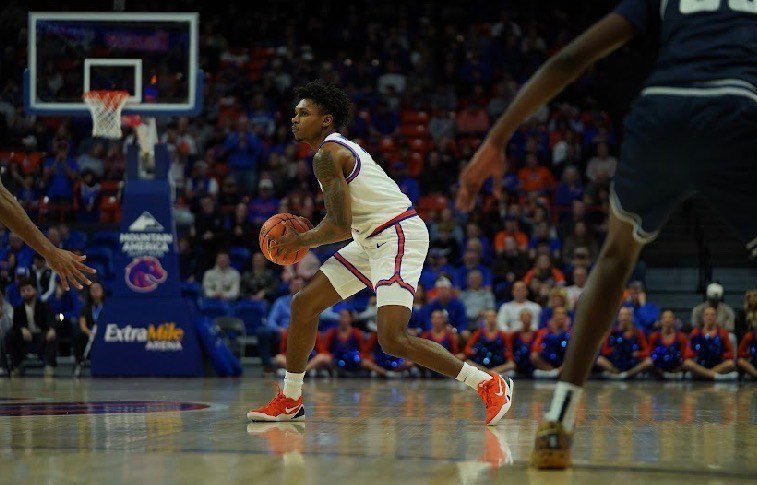
BOISE, Idaho – There are losses that sting, losses that linger, and then there are losses that fundamentally alter the emotional landscape of a season. Boise State’s 93–68 home defeat to Utah State was not just another mark in the loss column. It was a rupture. It was the kind of night that leaves a program staring into a mirror it does not recognize, asking questions that feel far too big for early January but impossible to avoid. At 9–7 overall and 1–4 in Mountain West play, the Broncos find themselves at a place few could have imagined when the season tipped off, a place that feels uncomfortably close to rock bottom.
The numbers themselves are harsh enough. Utah State walked into ExtraMile Arena and led for 98 percent of the game, building a lead that swelled to 32 points, dismantling Boise State with ruthless efficiency. The Aggies shot 57 percent from the floor, knocked down 44 percent of their three-point attempts, and turned Boise State’s mistakes into 23 points off turnovers. Boise State, by contrast, shot 37 percent overall, just 27 percent from three, and committed 12 turnovers that too often became runouts the other way. The final score read like a typo, the kind fans stare at on their phones hoping it will somehow correct itself.
But the box score alone does not capture the weight of what happened. This was the worst home loss of the Leon Rice era, a distinction that carries real gravity given the stability and success that Rice has brought to Boise State over more than a decade. It followed, uncomfortably and inexcusably, another home conference loss just days earlier, a 75–58 defeat to Grand Canyon that already had the fanbase uneasy. Two straight home losses in league play. Two games where Boise State never truly looked in control. Two nights where the margin between expectation and reality felt painfully wide.
Against Utah State, the Broncos were overwhelmed from the opening tip. The Aggies played with pace, confidence, and clarity, moving the ball crisply and attacking space with purpose. Boise State, meanwhile, looked tentative, disjointed, and unsure of itself. Possessions bogged down into isolation or late-clock desperation. Passes arrived a beat too late. Cuts were half-hearted. The offense did not flow because it was not being run, a point Leon Rice made clear in his postgame press conference when he said bluntly that his players are not executing the offensive scheme.
That admission hung heavy in the air. When a veteran coach publicly says his team is not running the offense, it signals more than a tactical issue. It suggests a breakdown in trust, in buy-in, or in understanding. Whatever the cause, the result on the floor has been unmistakable. For the second straight game, Boise State’s point guard play was alarmingly ineffective in terms of playmaking. Assists were scarce, ball movement was stagnant, and the offense rarely forced the defense to rotate. Against Utah State, Boise State finished with just 10 assists to the Aggies’ 19, a stark indicator of how disconnected the Broncos’ attack has become.
Dylan Andrews led Boise State with 16 points, and while his effort could not be questioned, the broader picture was troubling. Dominic Parolin added 12 points along with four rebounds and four assists, showing flashes of versatility. Pearson Carmichael chipped in 12 points, while Andrew Meadow had nine points and three rebounds. AG Neto scored six, Spencer Ahrens five, adding six rebounds, and the rest of the rotation struggled to make a meaningful impact. On paper, there was balance. On the floor, there was very little cohesion.
Utah State controlled the game in every area that matters. They dominated the paint, outscoring Boise State 40–26 inside. They punished mistakes, turning steals and deflections into easy points. They played with a freedom that comes from confidence, while Boise State played with the stiffness of a team afraid to make the wrong mistake rather than trusting itself to make the right play. The contrast was jarring, especially inside a building that has long been one of the toughest places to play in the Mountain West.
What made the loss even more demoralizing was how familiar the problems looked. Just one game earlier against Grand Canyon, Boise State endured another painful home defeat, losing 75–58 in a game that felt over long before the final horn. That night, the Broncos shot just 35 percent from the field and 21 percent from three, were out-rebounded, and again struggled to generate assists. The cumulative effect of those two losses has been devastating, not just in the standings but in the psyche of the team and its supporters.
This is a fanbase that has grown accustomed to winning, to toughness, to defensive identity, and to meaningful games in March. Over the last several seasons, Boise State has built a reputation as a program that does not beat itself, that protects its home floor, and that finds ways to grind out wins even when shots are not falling. To see that identity erode so quickly has left fans frustrated and searching for answers. Increasingly, that frustration has turned toward the coaching staff, a notable shift for a program that has largely stood united behind Leon Rice.
The reality is that championship teams do not lose home conference games, let alone two before the calendar has even flipped deep into league play. The Mountain West has never been forgiving, but it is especially ruthless this season, with multiple teams capable of winning on any given night. At 1–4 in conference play, Boise State has already put itself in a deep hole in the race for the regular-season title. The margin for error is gone. Every remaining conference game now carries the weight of a must-win, an exhausting way to live for a team still searching for its identity.
The most alarming trend has been the complete breakdown of offensive execution. Boise State is shooting just 33 percent from three on the season, a number that reflects not just missed shots but poor shot quality. Too often, three-point attempts come late in the clock, off the dribble, or without any advantage created by ball movement. The lack of assists underscores this issue. When the ball sticks, when players do not trust the system or each other, the offense becomes predictable and easy to defend.
Leon Rice’s postgame comments about players not running the offense were honest, but they also raise uncomfortable questions. Why is this happening? Is it a matter of personnel not fitting the scheme? Is it players pressing under pressure? Is it a leadership issue on the floor? Or is it a deeper disconnect between what the staff is asking for and what the players believe will work? These are not questions that can be answered easily or quickly, especially in the middle of a grinding conference season.
Defensively, the Broncos have also slipped from their usual standard. While the season-long numbers are not catastrophic, the last two games have been alarming. Utah State carved them up with ball movement and spacing, while Grand Canyon imposed its physicality and confidence. Boise State has always prided itself on defense as its foundation, the constant that travels when shots do not. When that foundation cracks, everything built on top of it becomes unstable.
The emotional toll of these losses cannot be overstated. Players walked off the floor against Utah State with their heads down, the energy drained from the building long before the final buzzer. Fans filed out in stunned silence, some angry, some resigned, all acutely aware that something has gone very wrong. The sense of demoralization is real, and it is dangerous. College basketball seasons can unravel quickly when doubt creeps in, when players stop believing that the work will pay off.
From a postseason perspective, the outlook has shifted dramatically. At this point, it is difficult to envision Boise State earning an at-large bid to the NCAA Tournament without a dramatic turnaround. The résumé simply is not there, and the path to building it has narrowed. Road wins are hard to come by in the Mountain West, and Boise State has already squandered the safety net of home dominance. In my view, absent an improbable 15-game winning streak to close the season, the most realistic path to the NCAA Tournament is through the Mountain West tournament and the automatic bid.
That is a sobering reality for a team that entered the season with much higher aspirations. It forces a choice. Boise State can dig in, play with desperation and pride, and try to win every remaining game with the roster and approach it currently has, hoping that continuity and grit will eventually produce results. Or it can treat the remainder of the regular season as a laboratory, experimenting with lineups, roles, and schemes to find a combination that can peak at the right time in March.
Neither option is without risk. Chasing wins without addressing underlying issues could lead to more nights like Utah State and Grand Canyon, further eroding confidence. Experimenting too much could cost games that might still matter for seeding or momentum. But doing nothing, pretending that everything will magically fix itself, feels like the worst option of all.
There are still reasons to believe this season can be salvaged. The roster has talent. Dylan Andrews has shown he can score and defend. Andrew Meadow has been a steady presence. Dominik Parolin brings versatility. Pearson Carmichael can score in bunches. The pieces are there, but they are not fitting together. The challenge for the coaching staff is to simplify, to restore clarity, and to rebuild trust in the system. The challenge for the players is to recommit to execution, to defend with purpose, and to play for each other rather than for individual solutions.
Rock bottom is not defined solely by losses. It is defined by how a team responds to them. Boise State is at a crossroads, facing a season that could either spiral further or become a testament to resilience. The margin for error is gone. The excuses have been exhausted. What remains is a choice about identity and direction.
The Mountain West will not wait for Boise State to figure it out. The schedule will continue to deliver challenges, and every opponent will see vulnerability where there once was certainty. Whether this 93–68 loss to Utah State becomes the moment the season truly collapsed or the moment it finally changed course will depend on what happens next.
For now, though, there is no escaping the truth. This was rock bottom. And from here, the only way out is through.