A Hard Ending. An Unclear Beginning.
December 14, 2025
Article By Nick Wade
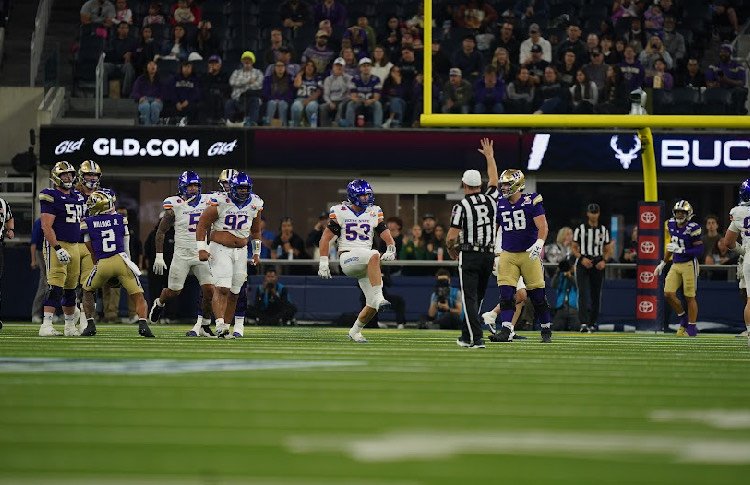
LOS ANGELES, California – The lights inside SoFi Stadium never dim, even when a season does. They glare and hum and reflect off a field that feels more like a stage than a battleground, and on Saturday night in Inglewood that stage belonged to the Washington Huskies. For Boise State, the Bucked Up LA Bowl ended in a sobering 38–10 loss that served as both a jarring conclusion to a historic Mountain West run and a blunt reminder of how unforgiving the next level of college football can be when margin for error disappears.
This was not how anyone inside Bronco Nation envisioned the final chapter of Boise State’s Mountain West era being written. The Broncos arrived in Los Angeles as three-time defending conference champions, riding the momentum of a rain-soaked, emotionally charged title game win over UNLV and carrying with them the pride of closing a league they once defined. They left Southern California with bruises, unanswered questions, and a clear understanding that the step toward consistent success against bigger, deeper, faster Power conference programs demands ruthless self-evaluation.
Washington, an 9–4 Big Ten team loaded with NFL-caliber talent across both lines of scrimmage, played the game Boise State needed to play but could not. The Huskies protected the football, dictated matchups, punished mistakes, and capitalized on every opening. The Broncos, by contrast, were forced to navigate the night shorthanded, compromised, and ultimately overwhelmed.
The absence that loomed largest came before the opening kickoff. Left tackle Kage Casey, widely projected as a first- or second-round NFL Draft pick, opted out to begin his professional preparation. It was a decision few inside the program begrudged, given the physical toll he has endured and the future awaiting him. Equally damaging, though less anticipated, was the absence of starting right tackle Daylon Metoyer, sidelined by injury. Losing both bookends of the offensive line against one of the nation’s most physical defensive fronts was a mountain too steep to climb.
Kyle Cox at left tackle and Jake Steele at right tackle were thrust into roles they had not spent the season preparing to own. To their credit, neither collapsed under the moment. They competed, communicated, and survived stretches that could have spiraled far worse. But survival was not enough. Against a Washington front ranked among the nation’s top twenty, Boise State’s protection cracked often enough to derail any chance of rhythm, especially with a quarterback whose health was already compromised.
Maddux Madsen’s return from turf toe had been the emotional spine of Boise State’s championship run. His grit, leadership, and resilience silenced years of criticism and culminated in a Mountain West Championship Offensive MVP performance that felt like redemption made flesh. On Saturday night, however, the injury that once seemed conquered re-emerged in full view. From the opening series, Madsen’s footwork lacked its usual snap. His base was narrow. His plant foot flat. The ball came out late and floated when it needed to drive.
By halftime, the damage was undeniable. Madsen finished the first half 7 of 14 for just 51 yards with two interceptions as Boise State trailed 24–3. One interception came on a throw he normally rifles into a tight window. The other arrived when his inability to step into the pass left the ball hanging just long enough for Washington’s secondary to close. When he returned for the second half wearing a boot, the decision to start him at all became a fair question. Trust is a powerful thing, and head coach Spencer Danielson has built his program on belief, but blind faith can become costly when the physical reality no longer matches the emotional will.
Max Cutforth took over and battled, finishing 15 of 27 for 202 yards, one touchdown, and three interceptions. The stat line told the story of a quarterback pressing in a game already slipping away. After the second interception, it was reasonable to wonder whether freshman Kaleb Annett might be given a series simply to change the energy. Instead, the night trudged forward, each possession heavier than the last.
The running game, the engine that was supposed to steady everything, never started. Dylan Riley, the heartbeat of Boise State’s offense all season, carried the ball eleven times for just 34 yards. Sire Gaines, whose power running seemed tailor-made for trench warfare games like this, managed eight carries for 18 yards. The numbers themselves were alarming, but the approach raised deeper concerns. Offensive coordinator Nate Potter repeatedly called inside zone concepts directly into Washington’s stacked box, challenging strength with finesse rather than leveraging angles or misdirection.
It was a puzzling stubbornness. Washington’s defensive front won leverage early, collapsed gaps, and forced Riley to absorb contact before he could reach the second level. Gaines, who thrives when he can lower his pads and punish defenders downhill, rarely found daylight. Part of that failure rested with the offensive line’s patchwork configuration, but play calling compounded the issue. Outside zone, counters, quick-hitting screens, and misdirection could have slowed Washington’s pursuit. Instead, Boise State continued to test a wall that never cracked.
Without a running threat, the offense became predictable. Play-action lost its bite. Washington’s linebackers sat comfortably in coverage windows. Boise State finished the night with just 58 rushing yards on 2.1 yards per carry, a statistical indictment that mirrored the eye test.
The moment that truly broke the game arrived in the second quarter and came not from offensive failure but from defensive overreach. With Boise State still within striking distance, defensive coordinator Erik Chinander dialed up an aggressive cover-three blitz, sending both Jeremiah Earby and Sherrod Smith on corner pressure. Washington quarterback Demond Williams Jr. saw it immediately. With the middle of the field vacated, he lofted a strike to NFL prospect Denzel Boston streaking untouched down the post. The result was a 78-yard touchdown that detonated the stadium and Boise State’s momentum in one breath.
From there, the Broncos were chasing shadows. Williams Jr., who finished 15 of 24 for 215 yards and four touchdowns, played with composure and confidence. His connection with Boston, who torched the secondary for six catches and 126 yards, underscored the challenge Boise State faces against elite receiver talent. Washington’s balance kept the Broncos guessing, and the defense, though competitive in stretches, spent too much time reacting instead of dictating.
There were individual efforts worthy of recognition. Marco Notarainni, named Boise State’s Defensive Player of the Game, recorded nine tackles, five solo, along with a sack and two tackles for loss. His motor never cooled, even as the scoreboard tilted further away. Buck Benefield added seven tackles and continued to look like the emotional compass of the defense. Bo Phelps chipped in six tackles and a sack, while Sterling Lane II flashed with three tackles and two sacks in limited opportunities. Jayden Virgin-Morgan recorded a sack, and the defense as a whole fought despite being placed in untenable positions.
Offensively, Chris Marshall was one of the few consistent threats, hauling in five catches for 97 yards. Latrell Caples added five receptions for 70 yards, and Matt Lauter caught five passes for 37 yards, including the lone offensive touchdown on a connection with Cutforth that came after the outcome was largely decided. Colton Boomer’s 52-yard field goal was another bright spot, a reminder of his reliability even when everything else unraveled.
The final numbers painted a stark picture. Boise State threw five interceptions and managed just sixteen first downs. Washington, by contrast, played pretty clean football, finishing with a turnover and turning mistakes into points. Football at this level rarely forgives such disparities.
Beyond the game itself, the night also carried implications for the future. Buck Benefield, who finished the season with 105 tackles, two interceptions, two forced fumbles, and was named Mountain West Championship Defensive MVP, stands on the brink of an NFL decision. Experts might project him as a potential fourth- or fifth-round pick, but his leadership, instincts, and production suggest his stock could rise further with the right evaluation process. In my opinion, Benefield should declare if it’s the forecast is confirmed by trusted draft experts. He has been the on-field leader all season, the emotional barometer of a defense that carried Boise State through adversity. Sometimes the timing aligns, and for Buck, this feels like that moment.
Kage Casey’s decision to opt out only reinforces the reality that Boise State is now navigating the same personnel challenges that define Power conference programs. Depth is no longer a luxury. It is a requirement. Injuries, opt-outs, and NFL aspirations are part of the landscape, and how a program adapts to those realities will define its ceiling.
The season as a whole deserves more than a narrow lens focused on one lopsided bowl loss. Boise State finished 9–5, secured a third consecutive Mountain West title, and closed its conference tenure in a way no program ever had. Maddux Madsen ended the season with 2,334 passing yards, eighteen touchdowns, and ninth interceptions this season, still only 20 career passing yards away from 7th all time in school history. Max Cutforth provided critical relief throughout the year, throwing for 1,059 yards and four touchdowns. Dylan Riley rushed for 1,125 yards and twelve scores, while Sire Gaines added 811 yards and nine touchdowns. Malik Sherrod contributed as both runner and receiver, and the receiving corps produced timely moments even amid inconsistency.
Defensively, Benefield’s 105 tackles anchored a unit that saw strong seasons from Notarainni, Zion Washington, Bo Phelps, Jeremiah Earby, Jayden Virgin-Morgan, Braxton Fely, A’Marion McCoy, and Jaden Mickey. The foundation is real. The culture is real. But Saturday night revealed the distance between foundation and fortress.
Closing the Mountain West era as three-peat champions matters. It provides momentum, credibility, and a banner that will hang long after conference logos change. But it cannot mask the work ahead. Boise State’s struggles against bigger, stronger, faster programs demand an honest offseason conversation. Personnel decisions must be guided by health, not hope. Play calling must evolve from stubborn belief to adaptable precision. Preparation must account for depth, not just starters. Emotional leadership, one of Coach Danielson’s greatest strengths, must be balanced with disciplined evaluation.
Sometimes, revisiting the roots of a program sharpens its future. Boise State built its identity on innovation, toughness, and refusing to be outworked. As the Broncos step toward a new conference and new expectations, that identity must be rediscovered with fresh eyes. The loss to Washington stung, but clarity and change often follows pain. How Boise State responds will determine whether this night becomes a footnote or a turning point.
The Mountain West chapter is closed. The next one begins now.