Heart of the Mountain
November 28, 2025
Article By Nick Wade
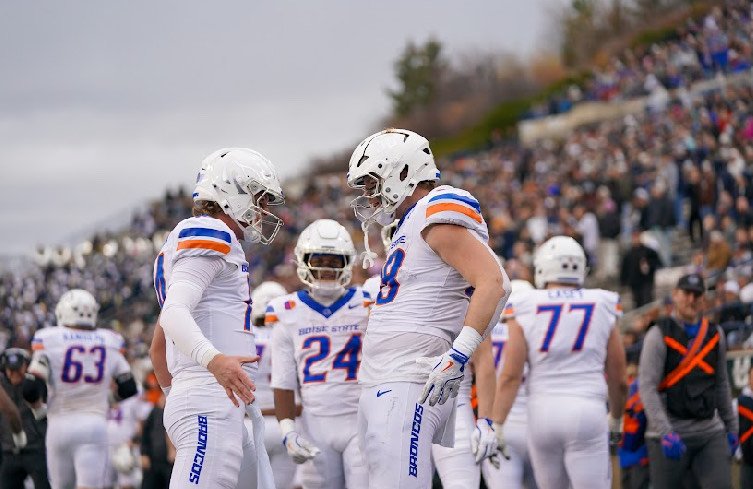
LOGAN, Utah – Boise State walked into Logan knowing the stakes, knowing the noise, and knowing that Utah State had not lost a single game at home this season. They walked out with a 25–24 win that felt like an emotional exhale and a declaration of resilience. In a season defined by twists, frustrations, injuries, and the constant demand to grow up fast, the Broncos found a way to snap the Aggies’ perfect home record and push their own path toward a Mountain West Championship berth into the final weekend of the season. The win lifted Boise State to 8–4 overall and 6–2 in the Mountain West, tying them with San Diego State and New Mexico before a Saturday slate that could either cleanly deliver title clarity or plunge the conference into full-scale chaos depending on the outcome of UNLV vs. Nevada.
The context surrounding this win was as heavy as the air in Logan during the fourth quarter. Boise State had to win to stay alive in the championship hunt, and they had to do it with a roster stretched thin by injuries, a quarterback room under scrutiny, and officials who threw two flags that fundamentally shifted momentum in Utah State’s favor. Yet the blue-collar identity of this team—what remains after the depth chart shuffles and the midseason doubts—surfaced at the very moment the Broncos needed it most.
Max Cutforth delivered his finest performance in a Boise State uniform, even if his stat line could have been even better had his receivers secured every catchable ball. Cutforth threw for 341 yards on 26 completions in 49 attempts with two touchdowns, pushing through pressure, dropped passes, and long-yardage situations created by penalties. What made his night stand out was not just the numbers but the timing of his best plays, including a remarkable 66-yard strike to true freshman Quinton Brown, who flashed star potential as he split the secondary and raced untouched for one of the game’s defining moments. Cutforth deservedly earned the Offensive Player of the Game honor, not because he played perfectly, but because he played with the composure and defiance required to win on the road against a team that had treated its home turf like a fortress all fall.
The challenges began early, though, and the Broncos had to beat more than Utah State. Two officiating decisions nearly broke them. The first came on what looked like a pick-six unfolding in real time, with Jeremiah Earby instinctively reading Bryson Barnes’ eyes, breaking on the ball, and getting his hands in position to make the game-changing interception. Instead, a soft pass-interference call erased the play and gifted the Aggies life they hadn’t earned. Later, Buck Benefield made what was called an interception in the end zone, only for the officials to levy a targeting call on Max Stege, who appeared to extend his hands—not his helmet—toward Barnes. The replay suggested the ruling should have been overturned, yet not only was the penalty upheld, Stege was disqualified and Utah State kept the ball, eventually scoring. Those two Utah State touchdowns came directly off officiating decisions that Boise State fans will be talking about long after the season ends, but the Broncos ultimately responded in a way that spoke volumes about their internal resolve.
Defensively, Boise State had no room for error facing senior quarterback Bryson Barnes, one of the most dangerous dual-threat players in the country with his combination of 2,502 passing yards, 18 touchdowns, and only four interceptions paired with 644 rushing yards and eight rushing touchdowns. Containing Barnes was critical, especially because Utah State entered the game undefeated at home with a top-25 offense. For all the stress Barnes created with his mobility, Boise State found the right players to make the right plays at the right moments. Bo Phelps delivered a statement performance with seven tackles, five solo stops, and two of them behind the line. His fourth-down stop with five minutes remaining in the fourth quarter was arguably the defensive play of the season. That moment changed the pulse of the stadium and gave Boise State the momentum they desperately needed. It earned him the Defensive Player of the Game award and perhaps a signature moment to cement his rise within the program.
Zion Washington added five tackles, Buck Benefield matched Phelps with seven tackles of his own, and Sherrod Smith also registered seven, helping steady the secondary after Max Stege’s ejection. Bol Bol contributed a timely sack that halted one of Utah State’s drives before it could generate rhythm. Boise State’s defensive front, which had struggled with consistency at times this season, held together long enough to give the offense one final chance to finish the job.
That finish came with grit and a renewed ground attack built on the shoulders of one player who continues to etch his legacy into Boise State’s storied running back lineage. With his 120 yards on 25 carries, Dylan Riley crossed the 1,000-yard mark for the season, joining one of the program’s most exclusive and celebrated clubs. His touchdown run was a reminder of his blend of patience and burst, and his ability to pick through traffic on inside zone plays was essential against a Utah State defensive front that dared Boise State to earn every inch. Riley’s toughness was matched by his versatility, helping open the door for play action pass for returning starter Chris Marshall.
Speaking of Marshall, the night was difficult for the normally reliable receiver. He finished without a recorded catch, dropping several balls that Boise State desperately needed him to secure. In his absence, Matt Wagner stepped into a larger role and delivered a breakout game with four catches for 64 yards and a touchdown. Wagner’s emergence may prove pivotal if Marshall continues to battle physical limitations entering championship week scenarios. Wagner’s touchdown grab was a product of trust between quarterback and receiver, with Cutforth sliding away from pressure and delivering a strike as Wagner shook loose from man coverage.
The growth of this offense over the final quarter was a testament to Boise State’s ability to adapt in real time, something they had lacked in previous losses when the playbook felt overly scripted. On this night, the Broncos not only adjusted but found ways to improvise and generate explosive plays down the field. The aggressiveness they showed late is something that must carry forward into what could be the biggest weekend of the season.
The win, though, did not just move Boise State to 8–4. It dropped them directly into the center of the most complicated Mountain West Championship picture in years. Boise State, San Diego State, and New Mexico all sit at 6–2 entering Saturday. If UNLV beats Nevada, the Rebels will join that group at 6–2, creating a four-way tie where the league’s tie-breaker rules stop pretending to be simple and instead shift to a composite of national analytical metrics. Those include Connelly’s SP+, ESPN’s Strength of Record, KPI rankings, and the SportSource Analytics index that the public often cannot fully access. The key element is that in four-way and three-way ties where each team has not played the others or where the round-robin results do not declare a clear winner, the Mountain West turns to those metrics to determine which two teams reach the championship game.
In the four-way 6–2 tie scenario involving Boise State, New Mexico, San Diego State, and UNLV, the head-to-head records within the tied group would be Boise State at 2–1, New Mexico at 2–1, San Diego State at 1–1, and UNLV at 0–2. Because not all teams played each other, the head-to-head round-robin cannot break the tie, meaning that the composite ranking metrics become the decisive factor Sunday morning. If only Boise State, New Mexico, and San Diego State finish 6–2, then all three would be 1–1 against each other. That deadlock, too, goes straight to the metrics.
For Boise State, the path remains clear at its simplest level: they had to beat Utah State to stay alive, and they accomplished that. Now they must wait and watch. None of the scenarious matter, though, without the win in Logan. And that victory, forged through adversity, shakiness, dropped passes, controversial officiating, big plays from unexpected sources, and a defensive stand that required absolute discipline, gave Boise State a puncher’s chance to three-peat in the Mountain West and exit the conference on a high. This season has been strange, exhausting, and unpredictable. But on Friday night in Logan, the Broncos showed something that metrics cannot measure and tie-breakers cannot quantify: the kind of heart that travels, survives, and believes.
If Boise State ultimately plays for the Mountain West Championship next week, it will be because of a night like this—one where their flaws were evident, their path was complicated, and their margin for error was thin, but they still found a way. After everything this team has endured, it would be fitting for their final chapter in the Mountain West to be written with a trophy in hand.