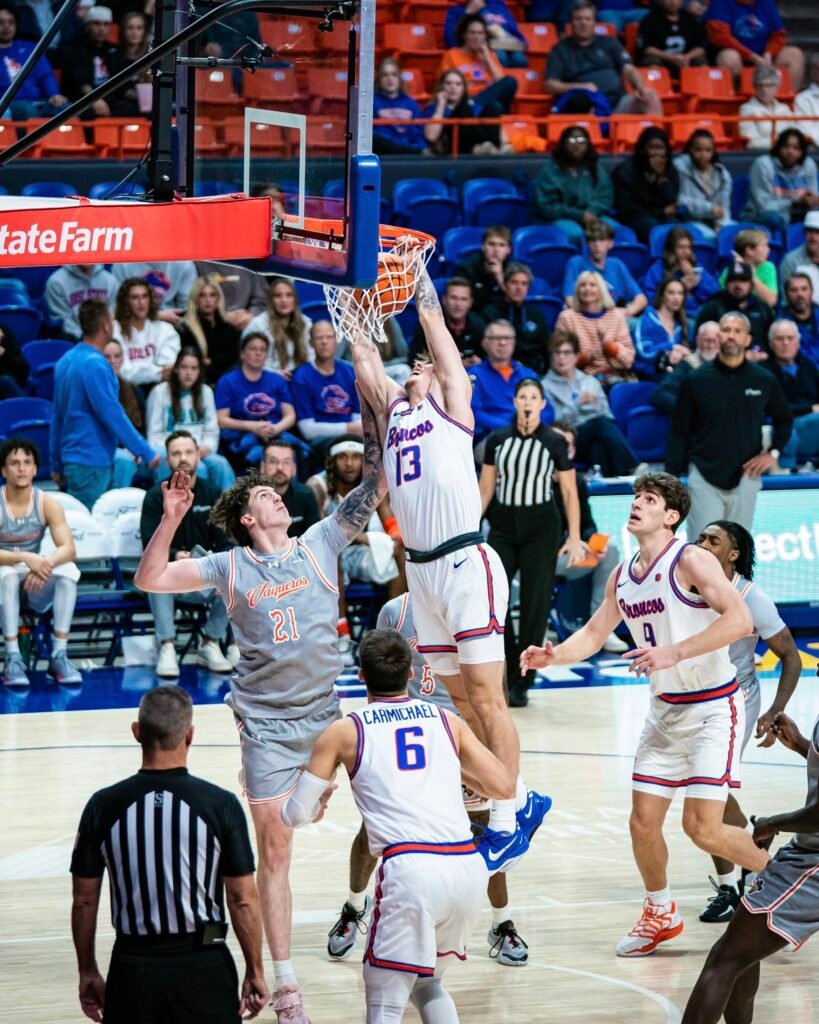
Boise State Cruises Past UTRGV 85–65 as Meadow Emerges as the Heart of the Broncos
November 12, 2025
Article By Nick Wade
BOISE, IDAHO – After a turbulent opening week that saw Boise State basketball suffer one of the most stunning losses in program history, the Broncos have responded with grit, focus, and a growing sense of identity. On Tuesday night inside ExtraMile Arena, Leon Rice’s squad delivered its most complete performance yet, dispatching UT Rio Grande Valley 85–65 to climb to 2–1 on the young season. It was a game defined not by a single dominant scorer but by cohesion, resilience, and the steady emergence of a new team leader in forward Andrew Meadow.
For the first time this year, Boise State looked like the team that Bronco Nation envisioned—a group capable of executing in rhythm, pushing tempo when needed, and finding confidence on both ends of the floor. Meadow, who has stepped up as the vocal and emotional centerpiece of the roster, once again set the tone with a performance that combined efficiency, leadership, and a touch of swagger. Scoring 21 points on 8-of-12 shooting to go along with five rebounds and three assists, he not only earned the game’s top honors but also validated what many close to the program have begun to notice: this team moves with his energy.
What makes Meadow’s growth even more intriguing is a subtle change that may be paying major dividends. Gone are his trademark protective goggles, a fixture that became almost symbolic of his blue-collar style. Now playing with contact lenses, Meadow has expanded his field of vision—literally and figuratively. His defense has sharpened, his anticipation off the ball has improved, and his rebounding awareness looks more instinctual. With clearer peripheral vision, he’s reading plays before they develop, sliding quicker into help defense, and closing out shooters with confidence. It’s a small adjustment that appears to have unlocked another level in his all-around game.
While Meadow has become the steadying presence, Boise State’s collective effort was equally encouraging. The Broncos shot 49.1 percent from the field and knocked down 10-of-22 from beyond the arc, rediscovering the offensive balance that went missing during the shocking home loss to Hawai‘i Pacific. This was not a team merely winning on talent—it was a team learning from its early-season embarrassment and growing from it. Each possession carried intent, each defensive rotation showed accountability, and each bench player contributed with purpose.
The most promising aspect of the night might be how comfortably Boise State cruised despite one of its stars, junior forward Drew Fielder, going scoreless. Fielder, who had dominated Utah Valley just days earlier with a 20-point showcase, was held in check offensively but still impacted the game defensively and on the glass. His ability to draw defenders and create spacing opened up driving lanes for guards like Dylan Andrews and allowed shooters like Meadow and Javan Buchanan to attack rhythmically. The Broncos didn’t rely on one man to carry the load, and that balance will be critical if they hope to build a non-conference résumé strong enough for KenPom and the NCAA selection committee to respect come March.
Speaking of Buchanan, the veteran forward provided his most complete performance of the young season. He tallied 15 points, grabbed seven rebounds, and added three assists and two steals, showcasing his strength and versatility in transition. Buchanan’s energy was contagious, especially in the second half, when the Broncos turned a single-digit game into a runaway. When he is engaged and attacking the rim, Boise State’s offense becomes exponentially harder to guard.
Dylan Andrews, the transfer from UCLA who was brought in to provide poise and backcourt leadership, continued to settle into his role as the floor general. Andrews finished with 12 points, three rebounds, and four assists, but his most valuable contribution came in his control of tempo. When UTRGV tried to speed the game up or trap in the backcourt, Andrews calmly directed traffic and delivered precise passes to open shooters. His ability to penetrate and kick out to shooters helped Boise State reach a blistering 45.5 percent from three-point range, their most efficient perimeter shooting night so far.
Spencer Ahrens continued to prove that his early-season success was no fluke. The freshman forward contributed 11 points, six rebounds, and an assist while demonstrating a maturity that belies his experience. He’s showing the poise of a veteran, finishing through contact and crashing the boards with conviction. There’s a quiet confidence in the way he carries himself, and it’s becoming clear that Ahrens is carving out a significant long-term role in this program. His energy and touch around the rim make him an invaluable asset in Rice’s motion-heavy offense.
Another freshman making his presence felt is AG Neto, the talented guard from Luanda, Angola. Neto has impressed with his composure and court awareness beyond his years. He tallied six points and two assists against UTRGV, playing within himself and making smart reads in transition. It appears to me that Neto and Ahrens are both on a trajectory to become great Broncos—not just for their current production, but for the consistency, effort, and attitude they bring nightly. Each game, they seem to absorb the pace and pressure of Division I basketball a little more comfortably.
Senior forward Dominic Parolin quietly had one of his best games of the season with nine points, five rebounds, and a steal off the bench. His physicality gave Boise State an interior presence that helped compensate for Fielder’s quiet night. Parolin’s minutes were filled with productive energy—he sealed defenders effectively, boxed out on every shot, and brought toughness that the Broncos needed against a UTRGV team determined to battle in the paint.
Despite the positives, there remains a glaring area of concern for Boise State: turnovers. The Broncos committed 20, a number far too high for a team with tournament aspirations. Those mistakes allowed UTRGV to hang around longer than they should have and disrupted offensive rhythm at times. It’s an issue that must be cleaned up as the schedule toughens, because future opponents won’t be as forgiving. The Broncos can’t afford to gift possessions and expect to maintain control in high-stakes games, especially once Mountain West play begins.
The defensive improvement, however, cannot be understated. After giving up 79 points to a Division II opponent on opening night, Boise State has responded with back-to-back performances holding teams under 80 and under 50 percent shooting from the field. Against UTRGV, they limited the Vaqueros to just 47.2 percent shooting overall and a modest 33.3 percent from deep, while dominating the rebounding battle 44–20. That margin on the glass reflects the Broncos’ renewed focus on physicality and discipline, something that was sorely lacking earlier in the month.
Leon Rice’s team also showed growth at the free throw line, though there’s still room for improvement. Boise State finished 19-of-29, a step in the right direction but not yet the level they’ll need in close conference contests. The Broncos’ defensive rotations looked sharper, their communication was clearer, and their willingness to dive for loose balls symbolized a team starting to buy into the details again.
Another subtle storyline to monitor is Pearson “Peanut” Carmichael’s start to the season. The sophomore forward has not yet found his full rhythm offensively, but flashes of his potential continue to emerge. He finished with nine points and two rebounds in limited minutes and showcased his signature athleticism with a pair of acrobatic finishes around the rim. It feels as though Carmichael is on the verge of a breakout game—once his confidence aligns with his natural explosiveness, Boise State’s frontcourt depth could become a true strength.
In total, seven different Broncos scored at least six points, another encouraging sign of the team’s evolving chemistry. This depth gives Rice flexibility in his rotations and allows the Broncos to stay aggressive without fatigue setting in late in games.
As the final buzzer sounded on the 85–65 victory, there was a sense of calm and confidence in ExtraMile Arena. The sting of opening night’s debacle has not been forgotten, but perhaps it was necessary. Adversity early can forge identity, and right now, Boise State is beginning to define who they want to be. Meadow’s leadership, Ahrens’ poise, Neto’s maturity, and Andrews’ steadiness form the pillars of a team that could still meet its lofty goals if it continues to evolve at this rate.
From my perspective, Boise State’s non-conference résumé will matter, but in truth, this season feels like automatic bid or bust. The Mountain West’s strength and the Broncos’ historical struggles in the NCAA Tournament mean that everything builds toward March. Yet, for one night in mid-November, Bronco Nation could take a deep breath and smile again. The team that stumbled out of the gate has begun to find its stride, and the rhythm looks promising.
Next up, Boise State hosts Montana State on Saturday night at ExtraMile Arena. It’s another opportunity to stack momentum, sharpen execution, and continue the climb back toward national relevance. If this version of the Broncos keeps showing up—with Meadow leading the charge and the young core growing around him—the early season turbulence might soon be remembered not as a warning, but as the spark that lit Boise State’s turnaround.