Broncos Facing the Break Point in San Diego: A Storm, A Stumble, and a Season on the Line
November 16, 2025
Article By Nick Wade
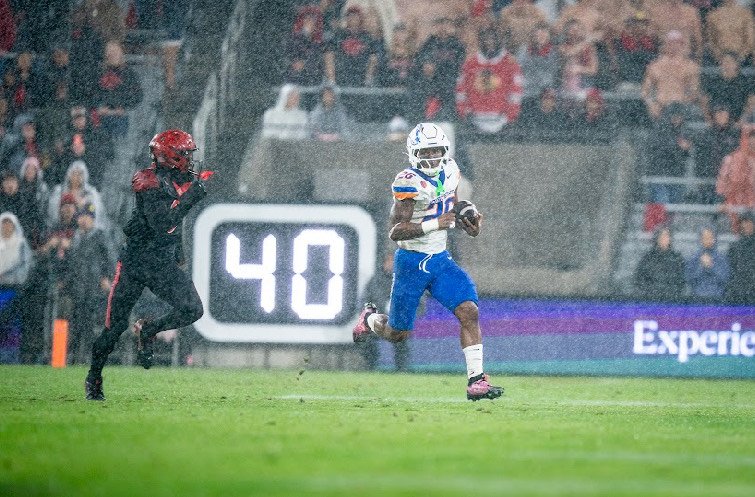
SAN DIEGO, California – Boise State walked out of Snapdragon Stadium on Saturday night soaked, battered, and with a performance that left Bronco Nation speechless for all the wrong reasons. The rain came in sweeping sheets, the wind carved sideways across the field, and the Broncos’ hopes of staying alive in the Mountain West title conversation washed away piece by piece in a 17–7 loss to San Diego State that felt even more lopsided than the score suggested. They are now 6–4 overall and 4–2 in conference play, a step from being mathematically eliminated and several emotional miles from looking like a team capable of contending for a championship.
There are losses that hurt because the opponent was simply better that night. There are losses that sting because the execution faltered. And then there are losses like this one, where the performance on the field carries the unmistakable weight of something deeper—hesitation, over-caution, a refusal to trust your own talent, and a complete collapse of offensive creativity at a moment when the season needed boldness more than ever.
The monsoonal weather was real, and it was ugly. Every camera lens at Snapdragon Stadium looked like it was pulled from the inside of a dishwasher cycle. The ball was slick, the footing treacherous, and the stadium’s open corners turned the rain into horizontal knives. But the weather wasn’t the reason Boise State lost this game. It was simply an accessory to a far more glaring issue: the Broncos never tried to win it through the air, even when the skies gave them windows to do so. And that decision, above any fumbles, missed reads, or broken tackles, defined the night.
The late scratch of standout receiver Chris Marshall, who rolled an ankle in practice, certainly didn’t help. Marshall was expected to return, expected to expand the playbook, expected to give Max Cutforth a lifeline in the passing game. Instead, without him, the Broncos shrunk the offense to the size of a shoebox. Not only did they avoid taking risks, they avoided taking chances that weren’t risks at all. What unfolded was one of the most predictable offensive game plans Boise State has put on the field in recent memory, an ultra-vanilla, physically constricted approach that communicated a concerning message: they didn’t trust their own quarterback. And that message reverberated every time the ball was snapped between the tackles into a stacked defensive box for the 10th, 15th, and eventually 22nd straight time.
What made it so puzzling is that weather breaks did exist. The monsoon came in waves, with long breaths of playable conditions between the worst of it. Those were the exact moments where even a simple play-action pass could have been deadly, especially with San Diego State creeping every available defender toward the line of scrimmage. But Boise State never even hinted at it. They remained locked into the tightest possible frame of their script, allowing the Aztecs to suffocate drives before they began.
The first half provided the most glaring example of this pass-shy approach. With just over four minutes left before halftime, Boise State’s defense held firm and gave the Broncos the ball with a full field ahead and a chance to steal points before the break. Spencer Danielson aggressively spent all remaining timeouts to preserve the clock, setting up a potential two-minute drill with about a minute and ten seconds left. The opportunity was perfect. The scenario was ideal. Momentum begged for a strike.
Instead, two conservative runs later, the Broncos lined up, looked at the down marker, and bled the remaining seconds as if protecting a lead instead of searching for one. The entire sequence communicated uncertainty at the most foundational level. You don’t run out a clock you’re trying to beat. You don’t fold a two-minute drill before it starts unless you don’t trust the arm leading it. Whether that message was intended or not, it was received loud and clear by everyone watching.
What also made the night confusing was that when Max Cutforth finally did get opportunities to throw—real opportunities, not desperation attempts with the game out of reach—he executed. His final line of 12 completions on 18 attempts for 104 yards wasn’t electric, but it also wasn’t the stat line of someone who deserved to be hidden for two-thirds of the game. By the time Max was unleashed, Boise State was down two scores, out of timeouts, and forced into a predictable passing mode against a defense built to tee off in those situations.
The core question emerging from this loss is brutally simple. If Boise State had so little intention of letting Cutforth actually play quarterback, why not lean into something else? Why not go to a wildcat package, or a change-of-pace quarterback, or even a hybrid look designed for wet-weather chaos? When you call 22 straight runs into the same defensive wall, it becomes impossible not to ask who the coaching staff is actually trying to protect.
And yet, even within the frustrating structure of the game, Boise State did find sparks. Sire Gaines was the improvisational heartbeat of the offense, turning collapsing inside lanes into lateral explosions, bouncing outside when the box suffocated, and producing the only moments where the Broncos looked alive. His 13 carries for 78 yards were hard-earned and often self-created. But even he wasn’t immune to the night’s miscues, including a drive-killing offensive facemask penalty in a game where the margin for error was already microscopic.
Dylan Riley, once again, embodied everything right about Boise State football. His 21 carries for 79 yards and a touchdown were delivered with urgency, violence, and consistency in conditions that swallowed lesser runners whole. He has become the team’s emotional accelerant, the player who forces defenders to decide whether they’re willing to take on punishment for four quarters. We awarded him Offensive Player of the Game, and it was an easy call. When everything else around him looked hesitant, Dylan ran with purpose.
But purpose without creativity is limited. Toughness without variety becomes predictable. And predictability against a defense ranked first in the Mountain West and sixth nationally is a death sentence.
The defense, which has carried so much of the season’s weight, finally showed cracks—understandable ones, but costly ones all the same. San Diego State’s stable of running backs, led by the relentless Lucky Sutton, found traction through a slippery field that erased angles and turned arm tackles into sled pushes. Once Sutton reached the second level, Boise State’s linebackers were often forced into solo situations on compromised footing, and SDSU exploited those matchups with patience and physicality.
Buck Benefield was everywhere, leading the team with eleven tackles and earning Defensive Player of the Game honors. Bo Phelps, Marco Notarainni, and Jake Ripp each contributed eight tackles of their own in a night that demanded physical endurance more than technical precision. The secondary, meanwhile, delivered one of the most dominant performances you will ever see wasted in a loss, holding San Diego State to just seventeen passing yards. That number almost doesn’t look real, but it’s a credit to a unit that continues to perform with pride and discipline regardless of the offensive output on the other side of the ball.
Time of possession ended almost even at 31:05 to 28:55, but the flow of the game never felt balanced. Boise State generated 268 total yards to SDSU’s 294. They averaged 4.0 yards per rush to SDSU’s 6.0. The Broncos out-passed the Aztecs 104 to 17, yet because the majority of those yards came long after the offensive script finally opened up, they may as well have been empty calories. The offensive stagnation was not born from inability. It was born from refusal. And that refusal points squarely to the coaching booth.
At this point in the season, offensive coordinator Nate Potter is under tremendous pressure. The lack of schematic adaptability, the persistent reliance on between-the-tackles repetition into loaded boxes, the reluctance to allow quarterbacks to play with agency—these trends are no longer isolated critiques. They are patterns. Patterns that every opponent now recognizes before the ball is even snapped. Patterns that will define how this staff is evaluated when the season ends.
It is time, in my view, for Dirk Koetter to become hands-on as an analyst. Not a whisperer. Not a consultant used sparingly. A fully integrated voice in reshaping the offensive identity before the remaining games slip through the Broncos’ fingers. The problems are no longer subtle. The corrections cannot be soft. And if the offense continues to stagnate, Spencer Danielson will be placed in the difficult offseason position of making personnel changes he never hoped to face this soon.
Yet even in frustration there is room for perspective. It is Spencer Danielson’s program. It is ultimately Jeramiah Dickey’s responsibility to decide what structural changes must happen. And for Bronco Nation—whose emotions tonight range from disbelief to exhaustion—the healthiest path forward may be returning to the five-year SMART plan I laid out in “The Standard” nearly a year ago. Boise State football is not rebuilt in a single season. Identity takes time. Culture takes commitment. Success takes structure. And setbacks like this, as bitter as they feel, are part of the journey of a program still becoming.
The Broncos return home next Saturday for a pivotal matchup against Colorado State at 5 p.m. on The Blue. Much remains at stake, even if a championship berth now feels remote. What matters most is not the mathematical odds, but the response. The urgency. The willingness to evolve. The readiness to trust the players whose talents are being underused. And the determination to prevent nights like the one in San Diego from becoming the norm.
Boise State still has everything it needs to win football games. The question now is whether it has the courage to call them.