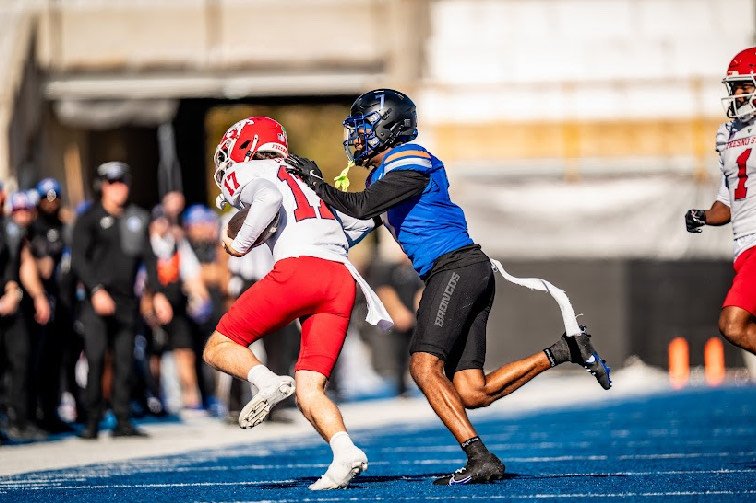
Boise State’s 16-Game Home Streak Snapped by Fresno
November 1, 2025
Article By Nick Wade
BOISE, IDAHO – On a day when Boise State’s pride and poise were tested in ways few anticipated, the Broncos suffered one of the most stunning defeats in recent memory, falling 30–7 to rival Fresno State in front of a stunned Albertsons Stadium crowd. The loss not only snapped Boise State’s 16-game home winning streak but also marked the program’s most lopsided defeat on The Blue since 1996, when Idaho dismantled the Broncos 64–19 during one of the program’s darkest seasons under head coach Pokey Allen, who was then courageously battling cancer. Nearly three decades later, the echoes of that night seemed to return as Boise State stumbled through one of the most deflating performances of the Spencer Danielson era.
The afternoon began with energy and optimism. Boise State entered the matchup at 6–2 overall and 4–0 in Mountain West play, still in firm control of its destiny to defend its conference crown. Fresno State, sitting at 5–3 and 2–2 in conference, came to Boise with confidence and motivation, having won the last two meetings—including the 2022 Mountain West Championship Game on the same field. From the start, the Bulldogs played like a team intent on keeping that momentum alive.
For Boise State, the night unraveled quickly. Junior quarterback Maddux “Maddog” Madsen—who entered the game ranked eighth all-time in Boise State passing yardage—suffered a lower leg injury in the first quarter, ending what had already been a challenging offensive start. Madsen was helped off the field and soon carted into the Olympic offices beneath the south end zone, visibly emotional with a towel covering his head. Later, he returned to the sidelines in a walking boot and crutches, doing his best to lift the spirits of his team. But by then, the tone of the game had shifted dramatically.
In the postgame press conference, head coach Spencer Danielson confirmed what fans feared: “He’s going to be out for a while.” It was a gut punch not just for the team but for a fan base that had come to view Madsen as the steady hand guiding the offense through the highs and lows of this season.
Backup quarterback Max Cutforth was suddenly thrust into action, and though he gave every ounce of effort, it was clear the offense wasn’t prepared for the transition. Cutforth finished the night completing 14 of 29 passes for 106 yards, throwing one touchdown but also two costly interceptions and a fumble. It wasn’t for lack of heart—the sophomore showed flashes of potential—but the offense sputtered without rhythm or adaptability. Fresno State’s defense took advantage of every missed assignment, every slow read, and every failed adjustment.
From my perspective, it was glaringly obvious that Boise State’s offensive scheme once again lacked creativity. For the second straight week, the game plan felt vanilla, predictable, and rigid. When Madsen went down, the play-calling didn’t evolve. There were no quick perimeter plays, no attempts to stretch the field, and no misdirection to slow down the Bulldogs’ relentless pass rush. I couldn’t help but think that the lack of preparation for a backup quarterback scenario was exposed in full view. While I have deep respect for Max Cutforth’s grit, I’ve long thought that Kaleb Annett might have the best spin on the ball among the quarterback group. In Spring Camp it was my opinion that he had earned the backup role. Perhaps, as Boise State uses the upcoming bye week to regroup, it’s time to take a longer look at Annett’s arm talent and composure under pressure.
Boise State’s lone touchdown came on a short connection from Cutforth to Chase Penry, who caught five passes for 44 yards and the only score of the game. Beyond that brief moment, the offense was bogged down by inconsistency and a lack of execution. The Broncos managed only 193 total yards—102 through the air and 91 on the ground. Against a Fresno State team that was stout but not impenetrable, those numbers told the story of a unit that simply couldn’t find its rhythm.
On the ground, the running back duo of Dylan Riley and Sire Gaines never had the chance to truly establish dominance. Riley, who had been averaging over 90 yards per game, was bottled up by Fresno’s front, while Gaines found little room to operate between the tackles. The offensive line, typically a strength, struggled to create running lanes or protect Cutforth for extended drop backs. Every drive felt like a grind; every first down felt like a minor miracle. For an offense that had shown flashes of brilliance earlier this season—particularly in wins over UNLV and App State —it was an afternoon of regression.
In contrast, Fresno State executed its game plan. The Bulldogs controlled possession, methodically wearing down the Boise State defense while leaning on their rushing attack, while their passing game was abysmal. Fresno State’s Carson Conklin completed 10 passes for only 35 yards.
For Boise State Malik Sherrod, who would later be named Offensive Player of the Game, ran with both purpose and explosiveness against his former teammates. Sherrod carried 10 times for 67 yards, including a blistering 44-yard run that gave Bronco Nation hope. His performance was a reminder of what Fresno State had lost when he transferred to Boise State —a dynamic, versatile runner capable of changing a game with one touch.
Boise State’s defense deserves recognition for its resilience. Though Fresno State scored 30 points, 14 of those came off turnovers that gave the Bulldogs short fields. The defense’s energy, led by safety Buck Benefield, remained unwavering even as the offense sputtered. Benefield was everywhere, racking up a career high 11 tackles (9 Solo) and providing emotional leadership when the game began to slip away. His intensity kept Boise State from completely collapsing, even as fatigue set in during the fourth quarter.
Another standout was Edge Jayden Virgin-Morgan, who finished with nine tackles and continued his reputation as one of the hardest hitters in the conference. The front line, anchored by Malakai Williams and Max Stege, fought hard in the trenches, but without offensive support, their efforts were often overshadowed. The Bulldogs consistently won the field position battle, forcing Boise State’s defense to start drives deep in their own territory.
Statistically, the game was closer than the score might suggest. Fresno State totaled 224 yards to Boise State’s 193—a modest differential—but the turnover margin told the real story. Boise State committed three turnovers (two interceptions and one fumble), while Fresno State played nearly mistake-free football. In a game defined by attrition and momentum, that disparity proved fatal. Time of possession also favored the Bulldogs, who controlled the clock for over 33 minutes compared to Boise State’s 26. Missed opportunities, penalties, and stalled drives combined to produce a night the Broncos will want to forget quickly.
As the clock wound down, the atmosphere inside Albertsons Stadium shifted from tense anticipation to quiet disbelief. The familiar roar of The Blue was replaced by uneasy silence. Fans who had seen Boise State pull off countless comebacks in this stadium realized that, this time, there would be no late-game magic. When the final whistle blew, Fresno State players celebrated at midfield, hoisting the coveted Milk Can for the third straight time —a rivalry trophy that has now remained in Fresno since 2022. The sight stung for players and fans alike, not just because of the loss but because of what it represented: a changing tide in the Mountain West’s most storied rivalry.
In the postgame analysis, the harsh reality set in. The path to the College Football Playoff—a dream that had already been flickering—was now officially extinguished. The focus, as Coach Danielson reiterated, must now shift solely to winning the conference . “We’ve still got everything in front of us in terms of the Mountain West,” Danielson said. “We control our own destiny, but we’ve got to respond. We’ve got to use this bye week to reset, refocus, and prepare to play our best football in November.”
There’s no denying that the defense continues to be the backbone of this team. Even with the loss, Boise State’s secondary remains one of the best in the conference, ranked among the top 30 nationally in passing defense. Players like A’Marion McCoy and Jeremiah Erby have been consistent difference-makers, with McCoy’s four interceptions and two defensive touchdowns this season highlighting the unit’s ability to create game-changing plays. Against Fresno, Erby once again showcased his ability to jam receivers at the line and disrupt timing, even if the scoreboard didn’t reflect his effort.
But as the defense continues to impress, the offense’s inconsistency has become a glaring concern. Offensive coordinator Nate Potter has faced increasing scrutiny for his conservative game plans and apparent inability to adjust mid-game. In back-to-back weeks, the Broncos have looked predictable, calling too many inside runs when defenses load the box and failing to utilize the full range of their offensive weapons. The loss of key receivers like Ben Ford to injury and Chris Marshall to suspension has undoubtedly hampered the passing game, but elite programs find ways to adapt. Boise State must rediscover that creativity, particularly with a backup quarterback at the helm.
Personally, I believe Potter has to rethink his approach entirely. The hallmark of past Boise State offenses—ingenuity, tempo, and balance—has been missing. When adversity strikes, as it did with Madsen’s injury, the playbook should open, not shrink. Running the same inside gaps and predictable passes against a disciplined defense like Fresno’s is a recipe for disaster. Going forward, the Broncos need to lean on their strengths: a stable of versatile running backs, an offensive line capable of pulling and moving laterally, and a defense that can give them extra possessions. The pieces are there; it’s about fitting them together.
As Boise State now enters a critical bye week before visiting 7–1 San Diego State on November 15, the focus will be on regrouping, healing, and rediscovering identity. The Aztecs, undefeated in conference play, represent the next major hurdle in Boise State’s quest to repeat as Mountain West champions. Winning on the road against a top-tier opponent will require sharper execution, bolder play-calling, and, perhaps most importantly, belief—a belief that this team can still rise despite adversity.
For Bronco Nation, the loss was sobering. The streak is over, the offense is in flux, and the season’s ceiling has lowered. But in true Boise State fashion, there remains a sense of defiance—a quiet conviction that this setback can serve as a spark rather than a death knell. In moments like these, programs define themselves not by how they fall but by how they rise.
As the sun was setting on The Blue Saturday night, players lingered longer than usual, soaking in the unfamiliar silence. Some knelt in prayer, others hugged teammates. Maddux Madsen, crutches under his arms, encouraged his teammates. It was a poignant image—a reminder of the human side of this sport. Madsen’s leadership, even in pain, embodied the culture Danielson is building: resilient, united, and relentless.
The final score—Fresno State 30, Boise State 7—will stand as a stark reminder of what can happen when execution falters and adversity strikes. But for the Boise State Broncos and their blue collar spirit and heart, the story is far from over. The Broncos still control their path to the Mountain West title, and in this program’s long, decorated history, redemption often follows heartbreak. The bye week will test their resolve, their preparation, and their adaptability. And come November 15 in San Diego, we’ll see whether this loss becomes the spark that reignites the fire—or the turning point that defined a season of missed opportunity.