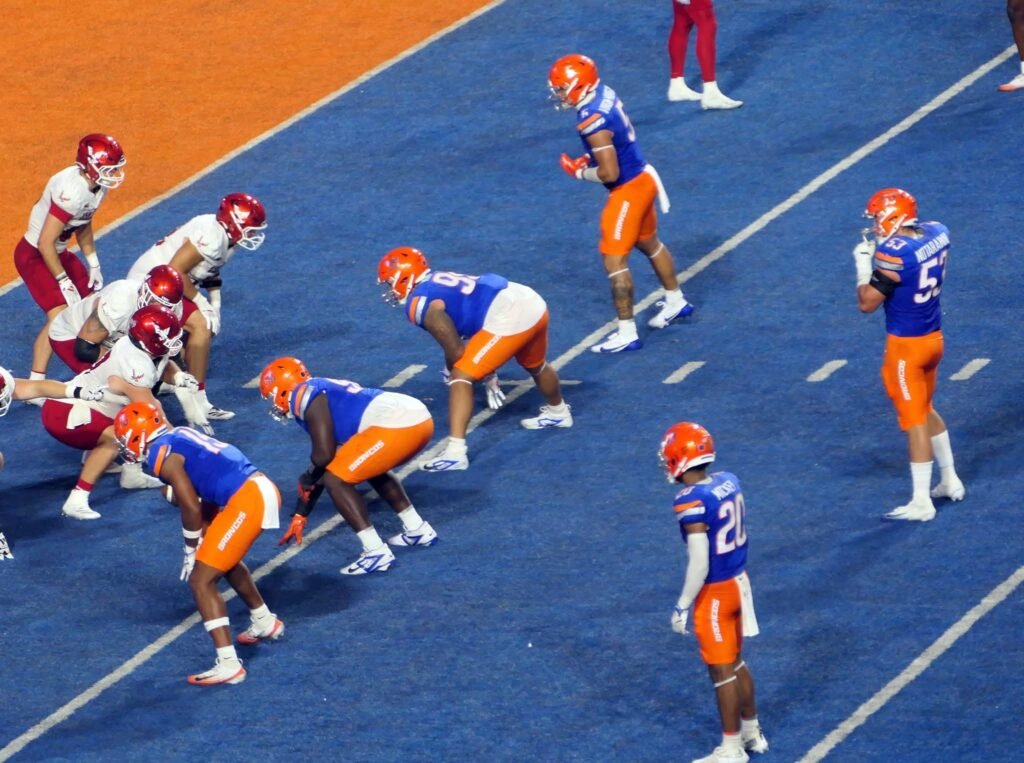
Boise State vs. Air Force: A Conference Opener of Contrasts and Consequences
September 16, 2025
Article By Nick Wade
The stage is set for Boise State’s first conference game of the 2025 season, and it comes in the form of a familiar and tricky opponent: the Air Force Falcons. Whenever these two programs meet, it is more than just a football game—it becomes a battle of philosophy, discipline, and execution. Boise State enters this contest with momentum and an improving roster that has shown flashes of dominance, while Air Force brings its signature triple option attack, a system that has historically challenged even the most disciplined defenses.
The historical backdrop of this matchup is not one Boise State can overlook. Since joining the Mountain West, the Broncos have been in several battles with Air Force that have left their fanbase both frustrated and humbled. In 2014, Air Force stunned Boise State in Colorado Springs, forcing seven turnovers and handing the Broncos their only conference loss that season. Two years later, in 2016, the Falcons again took down Boise State, denying the Broncos a chance at a New Year’s Six bowl berth. Those losses still linger as reminders that Air Force’s style of play can turn any game into a test of patience and precision. Even in the victories Boise State has earned against the Falcons, the games have rarely come easy, as the triple option has a way of keeping the score closer than the talent disparity might suggest.
The numbers entering this year’s game add intrigue to an already storied rivalry. Boise State comes into the matchup averaging well over 450 yards of offense per game, with a balanced attack led by quarterback Maddux Madsen, who has completed passes at an efficient rate while also keeping defenses honest with his mobility. The running back tandem of Sire Gaines and Dylan Riley has emerged as the one-two punch that gives the Broncos the versatility to attack both inside and outside the tackles. Gaines, with his powerful downhill running, sets the tone early in games, while Riley’s explosiveness makes him a constant threat to break a long run or create mismatches in the passing game. Together, they embody the identity of a Boise State offense that thrives on adaptability.
On the other side, Air Force brings its trademark offense that grinds defenses into the turf. The Falcons enter averaging over 300 rushing yards per game, ranking near the top of the nation in rushing production. Their attack is built on deception, timing, and relentless execution, with the quarterback operating as both a decision-maker and a weapon in the ground game. When Air Force is humming, they control the clock, limit possessions, and frustrate defenses that grow impatient with the constant pounding. While the Falcons do not throw often, when they are forced into passing situations, their efficiency drops dramatically. That is why I firmly believe that if Boise State can force Air Force into attempting 20 to 24 passes, the game will tilt heavily in the Broncos’ favor. Air Force simply does not want to operate in that manner, and the very structure of their system is compromised when forced to abandon the ground game.
Defending the triple option, however, is easier said than done. Success against it does not come from a single player making a highlight-reel tackle but from every defender doing his job with precision. The defensive line must occupy blockers without overcommitting. The linebackers must trust their keys, filling gaps with conviction. The secondary must remain disciplined, refusing to bite on play-action when Air Force occasionally tries to steal a big play over the top. Boise State’s defenders will need to show not only physical toughness but also mental resilience, as one lapse can turn into a momentum-shifting gain for the Falcons.
That is why the Broncos’ defensive leaders will be under the microscope. Buck Benefield’s presence in the middle will be critical to disrupting Air Force’s rhythm. Jaden Virgin-Morgan, with his quickness and strength off the edge, will be tasked with containing the perimeter and forcing the Falcons back inside. The secondary, anchored by transfers like Jayden Mickey, will need to balance physicality with awareness, knowing that Air Force will attempt a handful of carefully designed passes meant to punish any overcommitment. For Boise State, it will not be about stopping every play for no gain but about minimizing the damage and staying true to assignments.
Statistically, Boise State’s offense appears far more dynamic heading into the matchup. Maddux Madsen’s connection with emerging receivers like Chris Marshall and Ben Ford has given the Broncos a passing game capable of explosive plays. Marshall has stretched defenses vertically, creating mismatches that open space for Ford to thrive underneath and in red-zone situations. That balance between the air and ground attacks has made Boise State difficult to defend, and it will be a critical factor in this game. Air Force’s defense is disciplined and opportunistic, but they are not built to withstand a sustained aerial assault paired with a downhill rushing attack. If the Broncos can dictate tempo and force the Falcons to play from behind, the advantage will be theirs.
Still, for all the optimism surrounding Boise State’s offensive prowess, there is one area of legitimate concern: the kicking game. Through the early part of the season, the Broncos’ specialists have yet to prove they can deliver under pressure. A missed field goal or a shanked punt against an opponent like Air Force could completely alter the complexion of the contest. If the game remains close late into the fourth quarter, Boise State’s fans will have every reason to hold their breath, knowing that the outcome may hinge on a unit that is still finding its footing. For that reason, the Broncos must aim to put the game out of reach before special teams can even factor in.
The significance of this conference opener cannot be overstated. For Boise State, a win not only sets the tone for Mountain West play but also demonstrates that the Broncos are prepared to handle the unique challenges their schedule presents. For Air Force, it is an opportunity to once again play spoiler, as they have done in the past, by proving that their system can still frustrate even the most talented rosters. Both programs know the stakes, and both will enter with a belief that their style of play can prevail.
Ultimately, this game boils down to discipline, execution, and identity. Boise State has the weapons, both offensively and defensively, to separate themselves from the Falcons. The Broncos have shown flashes of being a team capable of not only competing for a Mountain West title but also making noise nationally. Air Force, meanwhile, will lean on its time-tested formula, hoping that precision and patience will wear down the Broncos. In my view, however, if Boise State can force Air Force out of their comfort zone and into throwing the ball 20 to 24 times, the contest should tilt heavily in their direction. If the Falcons succeed in shortening the game and keeping it within one possession late, then the concern shifts to Boise State’s unproven kicking game, an element that could undo all their hard work.
As kickoff approaches, fans in Boise and beyond understand the weight of this contest. It is more than just a game; it is a measuring stick, a test of discipline, and a chance for Boise State to show that they are not just contenders but standard bearers in the Mountain West. If the Broncos execute, stick to their assignments, and seize control early, the Broncos can show Bronco Nation they are poised for conference victories and build more momentum for the 2025 season.